


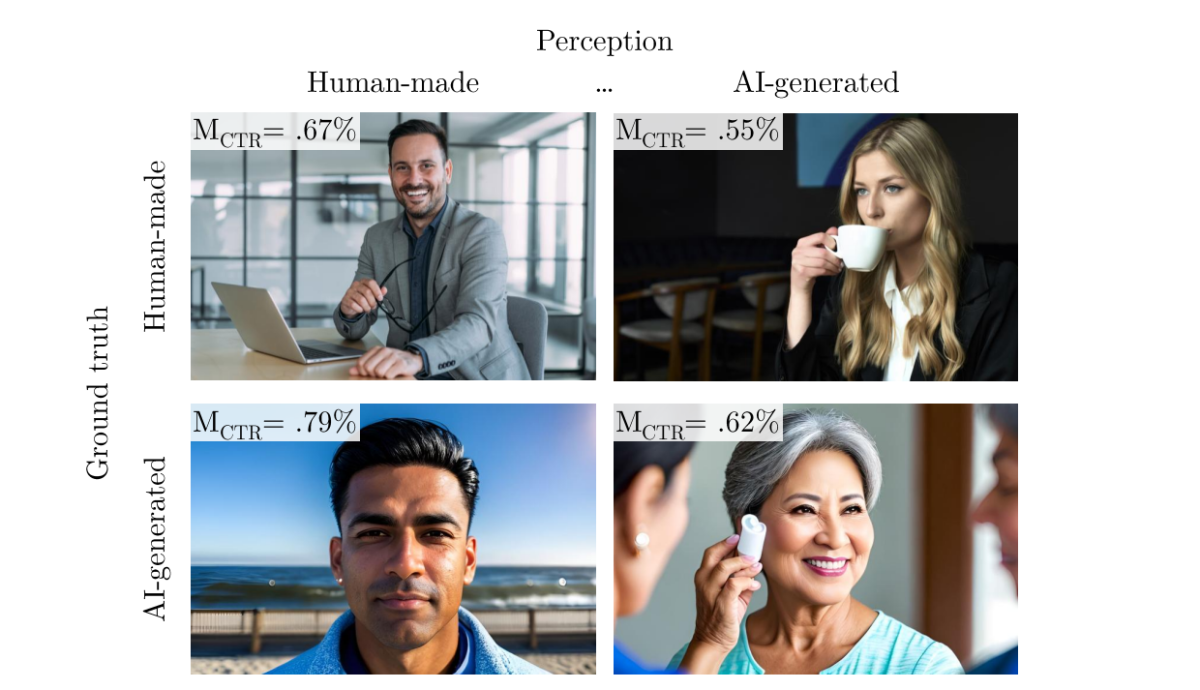
AI-generated ads generally work just as well as human-made ones, but AI-generated ads that look human-made perform even better, according to a study.
A Columbia Business School research paper compared the click-through rates of ads with AI-generated images and human-made ones served on publisher websites through Taboola during a one-month period in the second half of 2023.
Using a subset of the data containing 4,633 ads by 202 brands, the researchers designed a quasi-experiment*, and when they controlled for confounding variables, they found that images generated by Taboola’s AI tool engendered CTRs on par with human-made ones. Not only that, the researchers estimated that AI-generated images performed no worse than human-made content at converting those clicks into sales or downloads, either.
But when the researchers isolated the AI-generated ads that, according to a panel of participants, looked like they were made by humans, they saw that the CTRs surpassed those for ads that were really made by people.
The average CTR for AI ads that looked human-made was 0.79%, compared with 0.67% for human-made ads that didn’t look like they were AI-generated. On the other hand, AI ads that were correctly identified as being machine made had a mean CTR of 0.62%, while human-made ads that looked AI-generated scored the lowest of all, at 0.55%.
In the main, people aren’t very good at spotting AI-generated images. A panel of participants rated 24.87% of the human-made images as ‘likely’ or ‘definitely’ AI-generated, and 58.92% of the AI-generated images, as ‘not sure’, ‘likely’, or ‘definitely’ human-generated.’ According to the researchers, people tend to associate images that are clearer and feature larger faces with human creation, when in fact these are common traits of AI-generated images.
To see if the same dynamics were also true of newer AI tools, the researchers did a smaller test with models released in 2024 and 2025. They found that while these generators produced more convincing images, people still picked up on their artificial origins some of the time.
The researchers also used the wider Taboola dataset — which spanned two months and comprised over 300,000 ads and 16 billion impressions — to look for patterns in how brands use AI in their advertising.
There was no correlation between how successful or active an advertiser was and the adoption of AI. However, the paper states that ‘advertisers with a higher share of campaigns aimed at purchases or mobile app installs are significantly more likely to adopt the GenAI Ad Maker’s image generation feature.’
The results also showed that ‘advertisers in the categories pets, business, technology and computing, and real estate adopt the GenAI Ad Maker more frequently to generate ad visuals compared to the remaining industries.’
The paper is called AI in Disguise – Quasi-Experimental Analysis of a Large-Scale Deployment of AI-Generated Display Ads. It was authored by Yannick Exner, Jochen Hartmann, Oded Netzer,
Shunyuan Zhang and Ziqian Ding.
*It’s a quasi-experiment because the researchers used existing data about ads, rather than randomly assigning ads/brands into groups/conditions, as they would in a true experiment.