


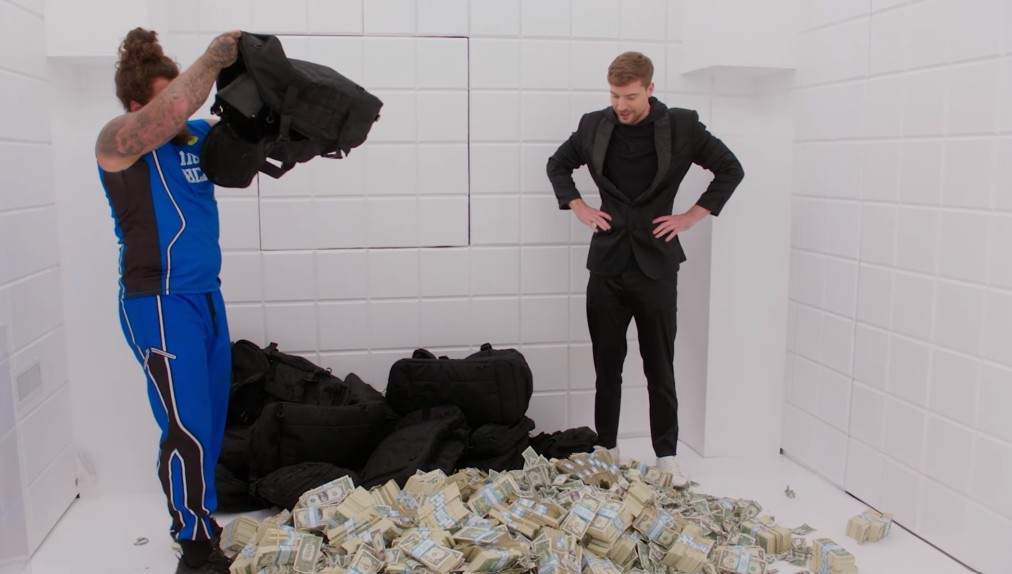
In October a group of mid-sized media commentary YouTubers were invited to tour the North Carolina production studios of Jimmy ‘MrBeast’ Donaldson, shown some episodes of his Amazon Prime show, Beast Games, and asked for their input and ideas.
Everyone on the tour was baffled about why they were there. None of the YouTubers invited share a large audience overlap with MrBeast. None of them produce content primarily about MrBeast or similar figures. Only one (Riccio Recaps) talks about reality TV shows, like Beast Games.
According to media critic and documentarian Dan Olson (of the Folding Ideas channel), everyone there initially assumed that the invitation was a scam, and one even demanded a video call to prove that Team Beast were really behind it.
In a video posted to YouTube earlier this month, Olson comes to the conclusion that they were brought in as a kind of specialised focus group. And out of all the questions that the guests were asked that day, one stood out to Olson as betraying a particular anxiety within Beast Industries — how do you create fandom?
It makes sense as the sort of information you’d seek from small-scale creators with channels devoted to movies and video games. But if Olson has read the situation correctly, why is the most successful YouTuber on the planet concerned about a fandom? And how do you go about creating such a thing?
The first thing to say is that a fandom is not necessarily the same thing as fans. There’s no clear demarcation between the two, but the difference is essentially one of time and money. Someone who likes all the Star Wars movies is a Star Wars fan; someone who attends an annual convention, makes their own fanart or fanfiction and owns an R2-D2 waffle maker is in the Star Wars fandom.
Modern fandom is said to have begun with the first Star Trek fanzine, Spockanalia (1967), edited by Devra Langsam and Sherna Comerford. But fandom has been taken to new heights since social media made it easier for people to find like-minded enthusiasts and loosened mainstream media’s grip on culture.
Fandoms haven’t changed the fundamentals of how brands grow. The assertion of The Ehrenberg-Bass Institute for Marketing Science that businesses ultimately succeed by attracting lots of light buyers still holds true.
That said, there are good reasons why all manner of brands, from E.l.f. Cosmetics to Taco Bell, are now courting them.
‘In a fragmented media landscape fandoms offer a stunningly ripe, albeit complex garden for engagement,’ wrote Ogilvy consulting director Reid Litman in a report for the agency last year.
At a time when the media has become so vast that no brand can comprehensively cover it all with a campaign, having a small army of people who will spend their downtime advocating your product for free has become incredibly useful for bringing in occasional buyers.
Extreme loyalists can also help brands make better products, according to marketing professor Mark Ritson, who makes his point by way of a comparison to medical research. ‘By studying a few abnormal humans,’ says Ritson, ‘scientists discover unexpected insights that might eventually shed more generally useful light on the rest of the population.’
For entertainment brands, fandoms are especially important, and not just because they’re the ones with the disposable income and the inclination to drop £100 on official Star Wars costume armour. Over a decade ago movie studios began losing their ability to essentially buy audiences for flop films because word of mouth from ‘lead users’ had become too influential to overcome with advertising.
If you take YouTube’s figures at face value, MrBeast has a gargantuan audience — 479 million subscribers to just his main channel alone. But, according to Olson, ‘he doesn’t have a fandom remotely proportional to his actual viewership’.
This is a problem for Donaldson. The creator has previously said that his channel is so big that few brands — except apparently Saudi Arabia, and possibly The Church of Jesus Christ of Latter-day Saints — can afford his reach. That’s why he creates his own products to promote.
But Olson cites ‘a quiet string of failures’ such as MrBeast Burger and MrBeast Labs toys as evidence that Donaldson hasn’t managed to cultivate the kind of dedicated following that he can rely on to support his new ventures.
Beast Games also shows that Donaldson struggles to lead his audience to new places. The Entertainment Strategy Guy (an anonymous but seemingly credible blogger) declared the show a flop after season two, which reportedly cost $150m to make and only appeared in Nielsen’s weekly top ten viewership ranks once.
Personally, my favourite metric of fandom is the fanfiction website Archive of Our Own, and Donaldson doesn’t fare well there, either. He is tagged in just 525 fanfics on the site. For context, Wes Weston, a character who was invented by fans of the 2000s cartoon Danny Phantom as a joke, is tagged in 887. Jon Snow, the protagonist of Game of Thrones, is tagged in 30,793.
Similarly, the Financial Times points out that, despite having a YouTube audience ten times bigger than that of a successful HBO show, MrBeast generates just a fraction of the search interest for specific plot points or the broader context of a video. This is sometimes referred to as ‘the lore gap’, and it’s an indication that few people think about MrBeast after they’ve stopped watching.
Not all of MrBeast’s ventures have failed. He sold $250m of his Feastables chocolate bars in 2024, according to Bloomberg. And for all his criticism of Donaldson, Olson acknowledges him as a ‘YouTube savant’.
Indeed, it’s indisputable that Donaldson has hijacked the attention economy like nobody before him. But that could be the problem. Like so many brands and creators that have excelled on specific digital platforms, MrBeast has optimised his way to enormous success. But that strategy is now chafing up against his stated ambitions to build a $100bn media empire akin to Disney, with movies and narrative fiction, and most importantly, real fans.
‘You build a fandom by making something that people want to watch because it’s fun or interesting or profound and not just because it hacks the attention pathways of nine-year-olds,’ says Olson.
I watched several of MrBeast’s videos while writing this article, and I can confirm they washed over me with the soothing effect of a weighted blanket, but I didn’t want to engage with them. Nothing in the videos sparked me to gush to my fandom friends, draw my favourite scenes or rewrite a version where it went differently.
Olson’s video made me go away and write an article about MrBeast. The only thing a MrBeast video made me write was a WhatsApp to my youngest cousin asking why he subscribed to this guy.