


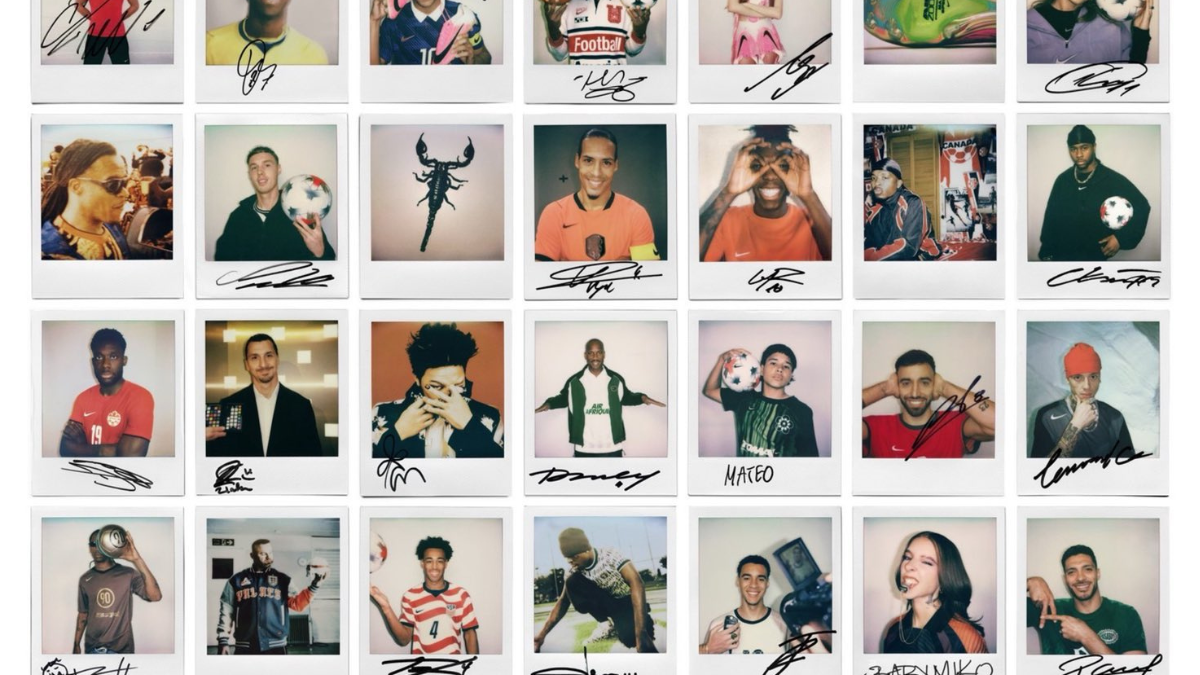
Nike’s World Cup campaign suggests the era of the blockbuster football ad is fading. In its place comes something more fragmented and more suited to the internet age, an approach the marketing economist Dr Grace Kite and Jellyfish’s Tom Roach call ‘lots of littles’.
Rather than unveiling a single cinematic centrepiece as it has for previous tournaments, Nike has this year opted for a rolling 12-week programme of collaborations, product drops and social content tied together by a sprawling cast of athletes, musicians and celebrities. Alongside stars such as Cristiano Ronaldo, Kylian Mbappé and Erling Haaland, the company has also enlisted non-football related celebrities like Kim Kardashian, Serena Williams, Travis Scott, Lisa and Young Miko.
The ‘12 Weeks of Football’ campaign was teased on 21 May through a series of Polaroid-style images released across social media, previewing what Nike described as ‘unexpected collaborations and cultural expressions’. In a statement, the company said: ‘We’re not dropping a big hero ad and moving on. We’re building an entirely new world of football.’
For decades the World Cup has been treated as a chance for brands to go all out, and none defined the trend like Nike. Its ads were expensive productions packed with football royalty and directed by film-makers such as Alejandro González Iñárritu and Terry Gilliam. Ads such as ‘Secret Tournament’ in 2002 and ‘Write the Future’ in 2010 were produced like mini-films, designed for a television era in which most audiences still gathered in the same place at the same time.
But today’s media environment looks very different. Audiences are dispersed across TikTok, YouTube, Instagram and streaming platforms, while internet culture increasingly revolves around creators, niche communities and algorithmic feeds. Brands aren’t really thinking about capturing one huge audience simultaneously, the challenge today is remaining visible across many smaller ones.
Nike’s current strategy looks built for that dynamic. On Monday, for example, the company released a short film featuring Wayne Rooney reciting Shakespeare to promote a collaboration between Nike, Palace Skateboards and the England national team. The idea could have easily been used as Nike’s centrepiece in previous years, but now it’s just one activation among dozens expected throughout the tournament.
Speaking earlier this month at Berkeley Haas, Nike chief executive Elliott Hill argued that ‘great brands in the future’ would need a global creative platform combined with more regional and local storytelling. ‘This idea of global to local,’ he said, ‘is real. It’s here to stay.’ Hill also acknowledged the role social media has played in reshaping consumer behaviour, noting that brands had once assumed platforms would make audiences ‘more alike’, but that the opposite had increasingly proved true.
That logic aligns closely with Kite’s ‘lots of littles’ theory. Rather than relying on one dominant execution, brands try to build effectiveness through many interconnected touchpoints with the aim of building up a coherent message formed from smaller activations. Kite argues that synergies between media channels once contributed roughly 20 per cent of campaign effectiveness; today the figure may be closer to 40 per cent.
The counter-argument to the ‘hero’ ad fading is Adidas. Nike’s great rival released a more traditional five-minute World Cup ad earlier this month featuring Timothée Chalamet and the likes of Lionel Messi, Jude Bellingham and Lamine Yamal — closer to the old playbook Nike itself once perfected. The advert has already attracted millions of YouTube views, suggesting the hero film still has life in it.

But Nike’s absence from that format says something about where large advertisers increasingly believe attention is heading. The future of sports marketing is not one defining advert watched by everyone at once, but to a constant stream of smaller moments designed to travel through culture piece by piece.
Update 05/06/2026: News of the death of the hero ad may have been greatly exaggerated as Nike releases a hero ad after all, featuring a plethora of stars. It will still pursue a ‘lots of littles’ approach but the ad shows Nike still sees the value in a blockbuster advert.
