


Something weird just happened on Tumblr.
Not normal Tumblr weird, like R-rated Stephen Universe fan fiction or a witch getting arrested for stealing human bones — tech-industry weird.
On 17 March, Tumblr published a post on its social media channels about updating the site so that when someone reblogs a post with a comment, all subsequent notifications go to that user, rather than the original poster, in a system much like X’s quote-retweets.

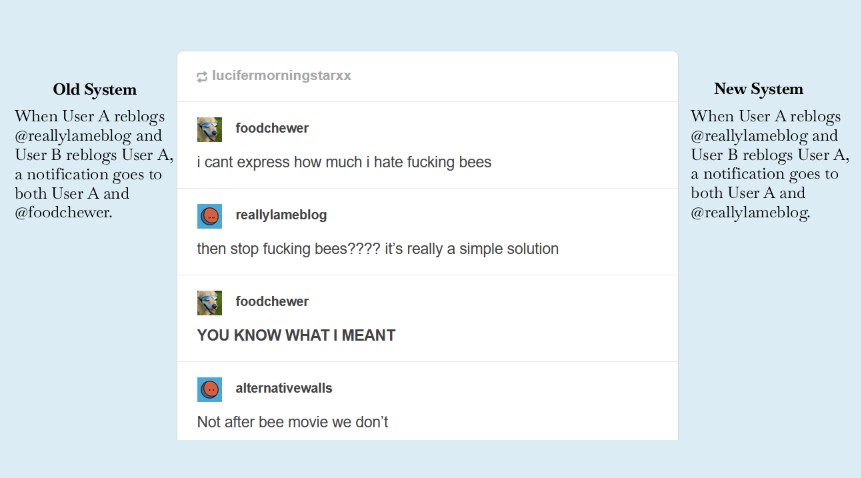
‘The reblog chain is one of the things that makes Tumblr unlike anywhere else,’ the post explained. ‘We want to keep encouraging conversations, and give contributors the recognition they deserve.’
The post attracted 48,000 comments and 161,700 reblogs within a day. For comparison, the previous update had 39 comments and 2,055 reblogs five months after posting.
Very few of these reactions were positive. I scrolled through the comments for 15 minutes and was able to find two users who were in favour of the change. While several users said they liked the idea of getting notifications on posts that they had added to, the fact that these notes would no longer go to the original poster was far less popular, with one commenting that it was ‘an anti-artist feature’.
Shortly after, Tumblr posted: ‘It’s very clear you all have strong feelings about Tumblr and about this change.’ This post made it very clear that, uproar or no, the update would go ahead as planned.
Then, hours later, it announced it was dropping the update altogether.
The site’s users reacted with an outpouring of joy and effusive thanks to Tumblr staff, God, and other users for averting a major change, not just to the site’s culture, but to the fundamental user experience of Tumblr.
The site’s reblog culture is one of its unique selling points. Many popular users have built a significant following, from user @pizza back in 2014, who reblogged any post about pizza pretending it was directly addressing her, to user @isuggestforcefem in 2024, who reblogged posts about irritating men with the suggestion that they be turned into women.
This belies Tumblr’s stated reason for the update: reblogs already ‘give credit’ to the reblogger by giving their username and linking back to their blog. The only effect of moving notes from the original poster to the reblogger seems to be making the site feel more like X.
It isn’t the first time Tumblr has undergone such a change. The site has received two influxes of users in recent years, nicknamed the ‘Twitter Exodus’ and the ‘Reddit Exodus’. As the names imply, both migrations took place after changes to the eponymous sites drove users to Tumblr. When the Twitter refugees arrived in 2022, Tumblr overhauled its interface to resemble the platform, stating that this would make the site ‘more intuitive’ for the new users. By contrast, when the Reddit refugees came a year later, no major changes were made to the site.
So what makes Twitter users such a valued commodity that Tumblr’s parent company, Automattic, is willing to repeatedly risk alienating its existing base to accommodate them?
Tumblr is famously unprofitable and advertiser-unfriendly. Some small businesses — like Palaeoplushies and NerdyKeppie — and authors perform well. TV shows and movies regularly hold paid Q&As on Tumblr to reach its fan communities. But the platform is mostly populated with mobile game ads, graphic porn ads, and seagull-based religious ads that are so weird that they have become a Tumblr meme in their own right.
The fact that Automattic sought to mimic X is still a sign of where tech execs believe that the advertising budgets lie. X might never have made money commensurate with its popularity and cultural influence, not even when it was still called Twitter. However, the plethora of copycat sites that emerged after Elon Musk bought the platform, and the willingness of both users and brands to return to it despite continued problems with harmful content, shows that there’s an enduring appeal to the microblogging format.
That appeal has only increased since the advent of AI, as LLMs prioritise real conversations when they scrape for information.
So, Tumblr’s executives are unlikely to give up trying to imitate X — particularly after a 2024 announcement that they would be selling access to users’ posts for AI scraping resulted in users making posts that were just strings of meaningless word salad intended to make such data unusable.
Indeed, Tumblr remains committed to changing its reblog structure: the post announcing the update’s cancellation says that ‘in the coming days’ the site will share more on how ‘a better version’ of reblogs will work.
But whether a platform can successfully mimic X’s mechanics and its popularity without also inviting the same problems with content, is another matter. Indeed, with a user base so hostile not only to change but also to monetisation in principle, that mimicry can introduce a whole new breed of problems.
As one Tumblr user put it: ‘The reason we like tumblr is because it isn’t like tw!tter [sic] or any other platform’.