


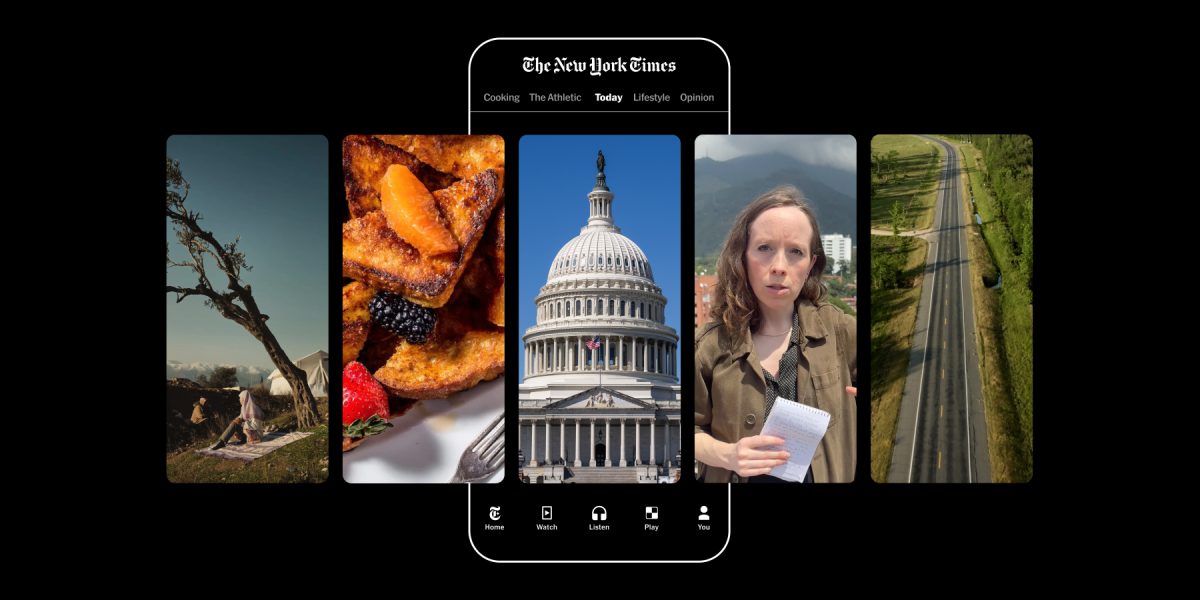
Almost 80% of news leaders polled by the Reuters Institute in 2025 said that investing in video would be important in the year ahead. The behaviour of publishers in 2026 has borne out that prediction.
The New York Times has arguably led the way, rolling out a TikTok-style Watch tab with a vertical short-form feed on its app homepage, with executive editor Joe Kahn describing the shift as a ‘race against time’. But the BBC, Economist and Telegraph are all at it, too.
We’ve seen this movie before, of course. Around 2015, publishers rushed into video because that’s what social media algorithms demanded. But as media commentator Brian Morrissey has argued, that wasn’t really a pivot to video; it was a pivot to Facebook. This time it’s different. Publishers are pursuing the shift on their own terms. The Guardian, for example, has expanded its video operation by adapting existing areas of editorial strength — from long-form journalism and interviews to formats such as Football Weekly — into video products designed to deepen engagement with its own audience. The difference is that publishers are no longer creating video simply to satisfy platform algorithms or chase referral traffic; they are building video products designed to strengthen their own brands and commercial models.
Why? The sociological explanation is that reading just isn’t as compelling as watching. That was the argument advanced by Rose Horowitch in The Atlantic, whose essay ‘The End of Reading Is Here’ struck a nerve among the media classes in July. The article resonated because it captured something many people recognise in themselves: a dwindling capacity for sustained concentration and an instinctive pull towards shorter, louder and more visual content.
There is clear evidence that deep reading is becoming less common. The National Literacy Trust has found that only around 20% of children and young people in the UK read daily in their free time — down from 30% in 2021, and a steep drop from historical cohort studies that estimated figures upwards of 60% in the 1970s. Horowitch writes: ‘The advent of reading and writing transformed society… The decline of reading will bring about changes of the same magnitude.’
It’s probably worth approaching the article with an element of caution — not least because The Atlantic has a habit of declaring the end of something every few months. (My personal favourite was The End of Men, published in 2010.) But those who dismiss the argument with claims that people are reading more text than ever, in messaging apps and social media, miss the point.
In the 80s, priest and English professor Walter Ong argued that electronic media, like TV and radio, changed how people communicate and think, reviving the dynamics of pre-literate societies. Sociologists like Zeynep Tufekci argue today that digital media does the same, even when it is primarily textual, by rewarding things like rhythm, wit and conflict over structured argument. As Horowitch notes in her article, ‘even text messages have taken on characteristics of the spoken word.’
This is just a theory, of course. The degree to which it’s even possible for a society to revert to oral traditions when almost every interaction is archived for posterity is debatable. But whether or not we’re unlearning the print psychodynamics that shaped the world over the past century, it’s still true that more people are now consuming information via online video. The Reuters Institute’s 2026 Digital News Report found that 54% of people now get news from social and video platforms, compared to 51% from news sites and apps. Pivoting to video, then, is simply publishers trying to adapt to consumer demand.
Video is more lucrative, too. There’s a good reason that almost all the social and streaming platforms are converging onto formats that look like TV — it holds attention and generates emotion like no other medium.
And as publishers produce more video, marketers will have access to a larger supply of high-quality inventory. What’s more, this new stock will be hosted in trusted and curated editorial environments, rather than the free-for-all of social media.
Those qualities may not have the same appeal in a culture ruled by oral psychodynamics, though.