


Brazil’s black market for exotic pets is enormous, with more than 30 million wild animals trafficked every year. A big part of the problem is cute social content. Videos of monkeys in nappies or snakes curled up on living-room sofas create desire and that desire feeds demand.
Ampara Silvestre, the country’s biggest wildlife protection organisation, asked Edelman for a campaign that could disrupt this cycle. They didn’t want another awareness push, they needed something that would interfere with the way the content spreads in the first place. As Edelman puts it: ‘The goal was not just to raise awareness, but to actively combat the normalisation and spread of wildlife-as-pet content online — content that, while often legal, plays a major role in creating demand and driving illegal trafficking.’
The team realised that lecturing people wouldn’t work. The problem was behavioural and algorithmic. Cute wildlife posts spread because people watch them and the algorithm learns to serve more of them. So instead of trying to out-educate the internet, Edelman decided to work inside the system. ‘We needed to work inside the platform, using the same dynamics that spread this content to suppress it,’ the spokesperson said.
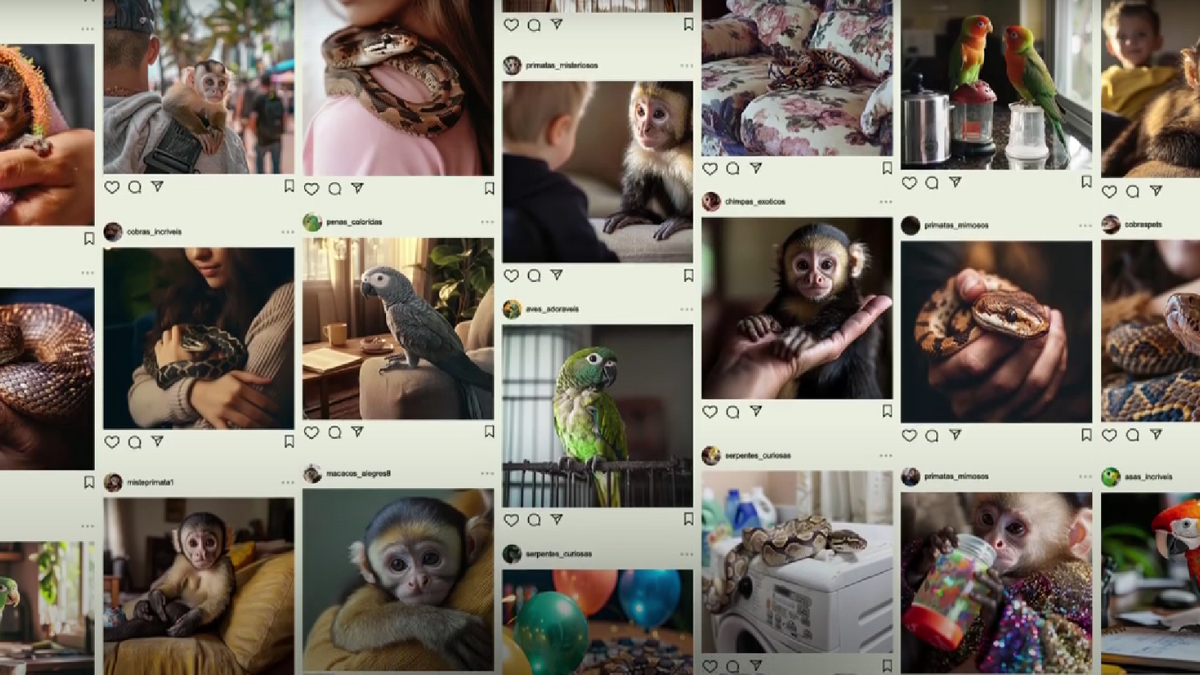
The idea was to create fake wildlife-pet content, then get people to report it. Edelman built 150 Instagram accounts and filled them with more than 1,500 AI-generated imitations of exotic-pet posts, with the same lighting, backgrounds and cutesy props. Then they partnered with influencers and mobilised Ampara Silvestre’s own channels to push a simple call to action: report these profiles.
Every report taught Instagram’s systems to downrank this type of content. The fake profiles vanished first. Then real ones started disappearing too; including accounts posting legal but harmful material. Execution relied on obsessive detail. The team spent months cataloguing the aesthetics of wildlife-as-pet content. AI was used purely to reproduce these patterns at scale.
The impact was immediate. Using Tubular data from 10–16 April 2025 (compared with the previous week):
- All 150 created profiles were banned
- 1,500 posts removed
- 92% drop in views on wild-animal videos
- 92% drop in average engagement
- 95% drop in total engagement
- 36% drop in total mentions
Ban This Profile sits within a wider movement of brands and nonprofits learning to intervene directly in platform mechanics, rather than just messaging around them.
Dove’s recent Real Beauty anniversary campaign is a good example. As generative AI began pumping out narrow, unrealistic beauty ideals, Dove discovered something unusual. Adding phrases like ‘according to Dove real beauty campaign’ into AI prompts produced more inclusive outputs.
Dove used this insight to build the Real Beauty DNA tool with Pinterest. Women could choose diverse images and positive traits to define beauty on their own terms, generating personalised videos and, crucially, reshaping their Pinterest feeds. Because the tool fed directly into Pinterest’s recommendation system, every interaction helped retrain the algorithm to prioritise authentic, diverse representations over AI-smooth stereotypes.
Campaigns that learn how to shape those underlying mechanics are fast becoming some of the most effective pieces of work in the industry. Ban This Profile is one of the clearest examples yet of how a brand — or in this case, an NGO — can change what people see by changing what the machine believes.