








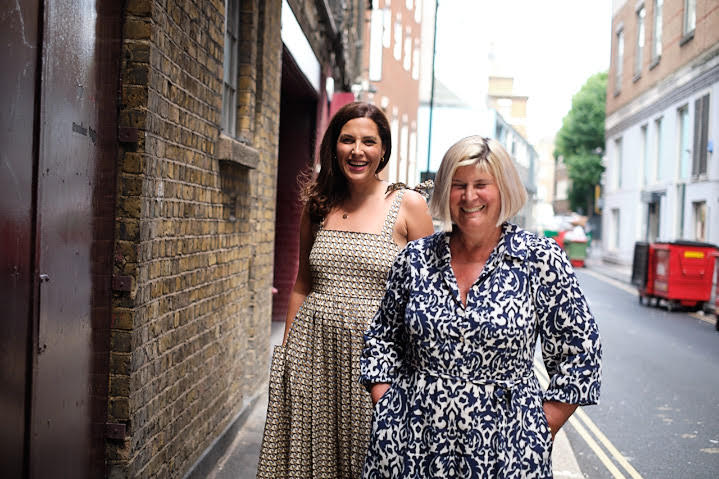
Jenny Jones and Sally Weavers co-founded Craft Media in 2018 after storied careers in media agencies.
As a comms planning agency, Craft doesn’t buy and it doesn’t make, in the words of its founders, so it can offer brand unbiased advice about how they can best use paid, owned and earned media to grow.
Given Kraft’s positioning as a sort of Switzerland of the marketing world, we thought it’d be fun to ask Sally and Jenny for their neutral take on a range of industry topics. And we were right — it was a lot of fun.
What’s comms planning, then?
Sally: It’s a very good question because everybody’s definition of comms planning is completely different. Which doesn’t help us sell it in, frankly.
I would argue that comms strategy is the process of helping a client understand what the role of communications is in the first place: where is the audience for growth and how can communications, in the round, help you solve the problem that you’re facing.
Comms planning, then, is the ability to deliver that idea across a whole suite of touch points, so helping to make an idea more famous through paid, owned and earned advertising — all adding up to more than they are on their own.
Jenny: It’s been sort of bastardised over the years by the industry, and comms planning has morphed into media planning, but paid [media] is only one part of a comms plan. So that’s why we have a point of distinction in the market, in that we plan across paid, owned and earned.
And who buys it?
Jenny: Smaller clients who respect strategy and understand that in order to grow, they need a roadmap for growth. And big clients who’ve lost their way: they’ve probably spent decades spending too much money and not really properly understanding why or what it’s doing for them.
Do you have a philosophy of comms planning? I think I’ve seen you talk about brands needing their own body language before.
Sally: That’s part of it. So, we’re vehemently anti-ultra-processed planning. One of the things that has happened this year — as we predicted — is that larger agencies have moved their AI chess pieces onto the board, and the net result is that we’re seeing five-out-of-10 plans, and we’re absolutely anti that. Clients will never reach their potential if they stick to that middle lane. We always plan for notice, not reach.
Jenny: It’s amazing how asking that question from the offset, how do I get somebody to notice this, immediately makes you think about things that aren’t advertising.
Sally: One of the discussions that we have quite often with clients is that they’re spending too much money, just pumping out the same messages in the same channels — usually in the same way as their competitors. So, of course they have to spend a load of money because they’ve got to use their voice in order to get noticed. If you start to think differently about how you plan, then you can afford to spend less because everything’s working so much harder.
Does that make you unpopular with some agencies?
Jenny: Not really… sometimes, I suppose; particularly if we go, ‘You don’t need to spend £10m, you can make do on £6m.’
Sally: I think we’ve been surprised but also delighted by how little animosity there has been from the industry. It’s a highly competitive, cutthroat industry — but it’s full of really nice people that want to do good work and actually that has enabled us, eight years down the line, to be sitting in this building, running a really successful business.
Who brings you in most of the time, brands or agencies?
Sally: A combination. Brands will come directly to us, and usually that’s a client-to-client referral. But creative agencies will often bring us in as well; they love our philosophy of making an idea bigger and more famous, rather than shrinking it into six-seconds, or an MPU.
I don’t know what an MPU is.
Sally: It’s a little square on the… it’s the shit on the internet.
Little Black Book published an interview with you earlier this year titled: Could 2025 Be The Year Comms Planning is Valued? Has it been?
Sally: I would say that the year has played out more slowly than we thought. But I do think that the larger networks have played their move now, and I think we’re moving into a period where comms planning starts to come to the fore because clients are going to get pissed off with the amount of ultra-process planning that they’re receiving.
On a scale of one to 10 — one being couldn’t have gone worse and 10 being couldn’t have gone better — how would you rate 2025 for the ad industry?
Sally: Six
Jenny: Oh, you’re generous. I would have gone smack in the middle at a five. You read some takes and it’s like advertising’s finished — AI’s gonna eat us all. I don’t see that. I’m still working with brilliant teams on great briefs with exciting clients that have got ambition. However, I think our confidence and our narrative and our self-belief has definitely been affected this year, and we’ve lost a bit of our own body language as an industry. I still think it’s the best bloody job in the world. When it’s good, it’s brilliant. So, I think a little bit of our own body language needs to come back — a bit of swagger.
Using the same scale, how do you think 2026 will go?
Sally: I’m gonna say six again because I think it’s really slow to change. We’re so lucky, we’re so small and so nimble, we can spin on a sixpence. But the big agencies have really got some hard work to do next year.
There’s been a few big media debates in 2025, and I’d like to ask for your neutral take. First, is YouTube TV?
Sally: It’s audio-visual, but it’s not the same as telly. There’s so much research on how telly is way more effective than YouTube. The proximity to quality content and quality advertisers is a part of a brand’s body language, and I don’t think you get that on YouTube.
Jenny: This is where the fun happens because I disagree with that. I think we can turn ourselves into massive snobs if we don’t appreciate how different people consume different forms of entertainment or information. YouTube does a really important job, and a bigger job than telly to some people.
We’ve got a client who does full jaw replacements. So you’ve got to find people in the UK that have less than six working teeth in their mouth and £20,000 to spend on a full jaw replacement. YouTube’s been very useful for that because, with the layers of data that we can build into it, we can find those people.
Is fragmentation as big of a deal as we’ve made it out to be in the industry, given that we still have megastar singers and people gathering around big sporting events?
Jenny: Has it changed the industry? Yeah, it has because a load of bloody money’s been sucked up by two enormous tech companies. It used to be that we’d spend money with media owners who would input into culture, so I’d give money to ITV and they’d make more programmes. I’d spend money on newspapers and they’d hire journalists that would report on the world. Those tech giants don’t put back into culture; that money gets taken away and we are all suffering from that. That is my perspective on it, so it has changed the industry.
Do you think fragmentation has changed how famous a brand can expect to get?
Jenny: I think that a lot of that depends on the bravery and creativity of the brand. Creativity is still the biggest driver of effectiveness, and I think you ignore that at your peril.
Earlier in the year I came across the argument that now audiences are spread across more channels, the ability to create fame is reduced because there are fewer places where people not only see a brand but know other people are seeing the brand on the same channel. Have we lost that?
Sally: I think you have to work much harder now to find those moments. It used to happen every evening in front of the TV, or when you’d put the radio on. It doesn’t happen like that anymore, so you have to be much more judicious about where you place your bets for those cultural moments when people come together.
Jenny: But it’s also utilising your own backbone of businesses. We had a conversation last week with a client where I pointed out that their vans driving up and down the street is the equivalent of a £34m media spend every single week, and they were doing nothing with them.
Are brands and agencies getting too excited about influencers?
Sally: I’m a bit brutal when it comes to influencers because. I sort of feel like they’re just not creative enough. I watch TikTok, and oh my God, it’s the same format of content. There’s no creativity, there’s nothing interesting. They’re playing to the algorithm, and the algorithm moves to the middle lane. It’s ultra-processed planning again.
Jenny, you said it’s important not to be snobbish about YouTube content. Do you feel the same way about AI generated content?
Jenny: The strategist in me says that low involvement processing as a form of communication has a role to play in a communications plan. And if the way to best deliver that cost efficiently is through the use of AI, great — if it then frees up humans to think about the bigger, more complex problems that they can solve with creativity. So, I think you’re crazy to say it’s not important. For a lot of small brands built on the internet, this will be the only way that they can scale their business, so they should absolutely lean into it.
Is principal-based principal-based media buying fair enough, given that agency services are undervalued, or is it a pernicious practice?
Sally: I would say, if clients know about it, if agencies are open with the level of margin that they’re making, then it’s perfectly fine. The issue is that clients often don’t know that the media that they’re being recommended is part of a principal-based buy. This has been around for decades. I remember working in a media agency and whatever brief came in, the trading director would say: ‘Could the answer be a partnership with the Daily Express?’ Because they had pre-bought a load of value at the Daily Express.
What’s the most interesting comms planning you’ve seen this year, neutrally speaking?
Jenny: I’ve made a list. Did you see the sumo wrestling in London? Did you see that across multiple different touch points the pictures of sumo wrestlers on bicycles? And then did you see the winner of the sumo wrestling receive a ginormous Kikkoman soy sauce trophy? It was brilliant and impactful, and what an insane bit of strategy and thinking in terms of the sponsorship of something that was going on in London, and it’s been on the front page of every newspaper. I think the joy and the silliness of what we do came out in that because there was no AI plan that would have told you to put all your money into this one event and give the winner a bottle of soy sauce bigger than a baby.
I love the work for The Ordinary that Uncommon is doing. I think that’s proper comms thinking. It doesn’t start with an ad, it starts with a problem. They clearly don’t have massive budgets, but that’s not constrained the creativity that they’ve put in there.

And I think the work we’ve done for Ancient + Brave this year… Last year they were our tiny client, and it was like, ‘Do we put some money on Facebook?’
And Sally went, ‘Absolutely not. Instead, go and do a deal with Davina [McCall].’ Having an endorsement deal with somebody of influence, and the conversation she’s driving around menopause, will have a much bigger impact.
And this year they’ve come back. We have the Davina effect every time a spot goes out. It’s just a really effective bit of work, and it’s multi-market now as well.

My last one is the work we’ve done with the National Literacy Trust. Next year is the year of reading, and the focus is on teenage boys, in particular. We’re doing a roadshow to get the image of reading more prevalent in culture. So, we’re asking [creative partners] that if you make anything next year, can you include an image of somebody reading? Don’t pull out the phone, have them pull out the book instead. We’re doing the same with TV partners, to get more people on, say, Coronation Street, in the cafe with a book. To me that’s comms strategy: thinking about other ways we can influence the problem.
You can listen to the full conversation with Jenny and Sally in the MediaCat UK podcast, here.