


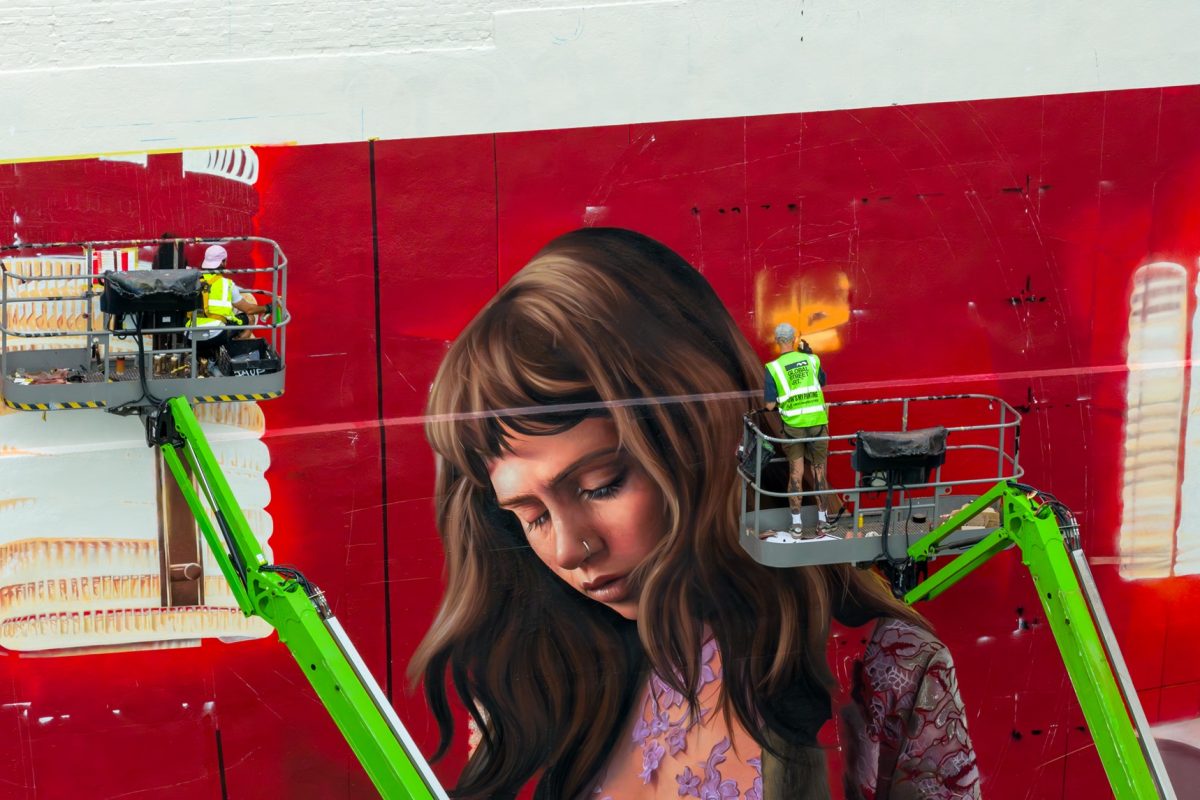
When it comes to digital media, we often gloss over the conflict between advertisers and consumers…
Brands paying for their ads to be seen and audiences actively paying not to see them! A ‘get paid twice’ formula for tech giants but a clear reminder that advertising is broken.
In a world of infinite scroll, shrinking patience and constant digital noise, earning attention for brands has never mattered more.
As a passive ecosystem, OOH must earn attention to be effective, which offers a unique opportunity for creatives to entertain in a truly public setting.
The role of murals
Some of the most effective advertising still comes from something unmistakably human — a place where craft, culture and creativity go hand in hand. I hold the belief that human creativity has the power to make ‘all things new’ in a world preoccupied with ‘all new things’.
Murals transform OOH into a storytelling space; a canvas people don’t just look at but move through and feel.
With a refreshing combination of skill and scale, artists are summoning attention with eye-popping, jaw-dropping, spine-tingling work.
Hand‑painted murals create stronger emotional intensity than other static formats. Emotion fuels memory. Memory fuels mental availability. And mental availability drives choice.
Investment into creativity, whatever the channel, demonstrates a brand’s faith in its own product. What separates hand-painted advertising is this process of human craft; a group of artists giving a piece of themselves to every project.
Unique environments drive unique behaviours
An important quirk about murals is that every wall is totally individual. A bespoke shape and size with its own charm, eccentricities and character.
Mural locations are the non-conformists in a media landscape built around uniformity and predictability. As an OOH medium they disrupt the status quo.
When artists are actually painting, it’s impossible not to look. And when humans put real effort into creativity, audiences assign it more value. Craft becomes part of the message.
As Rory Sutherland says, any communication which involves a high degree of difficulty or scarcity in its creation is a more impactful communication.
Stop‑and‑Stare = Stop‑and‑Share
The clearest sign a mural has earned attention is when it travels into culture.
When murals reflect the cultural moment, they feel alive — LIDL being a perfect example of playing with culture and chiming with a public moment.
Social proof has a big role to play in OOH. To quote (former CSO of Saatchi & Saatchi) Richard Huntington: ‘It’s not just that you see the message, it’s that everyone sees the message, and everyone knows everyone else saw the message.
The best murals turn ‘stop and stare’ moments into ‘stop and share’ occasions, generating online reach through earned social media and mainstream PR.
Digital content featuring murals is still consumed through a lens of cultural imprinting, building a bridge for audiences between the physical world and social media.
Hand-painted advertising has the power to bring some of the best ideas to life; to entertain and harness attention in an authentic way. A shareable human-to-human bond, not easily broken.
Benjamin Fishlock is head of client strategy at media owner Global Street Art. Reach out to Ben to visit Global Street Art’s epic Old St, London HQ, to better understand the inspiration and process behind painting, visit their hidden museum of over 100,000 objects, and to see many of their exclusive local media sites. You will be inspired!