



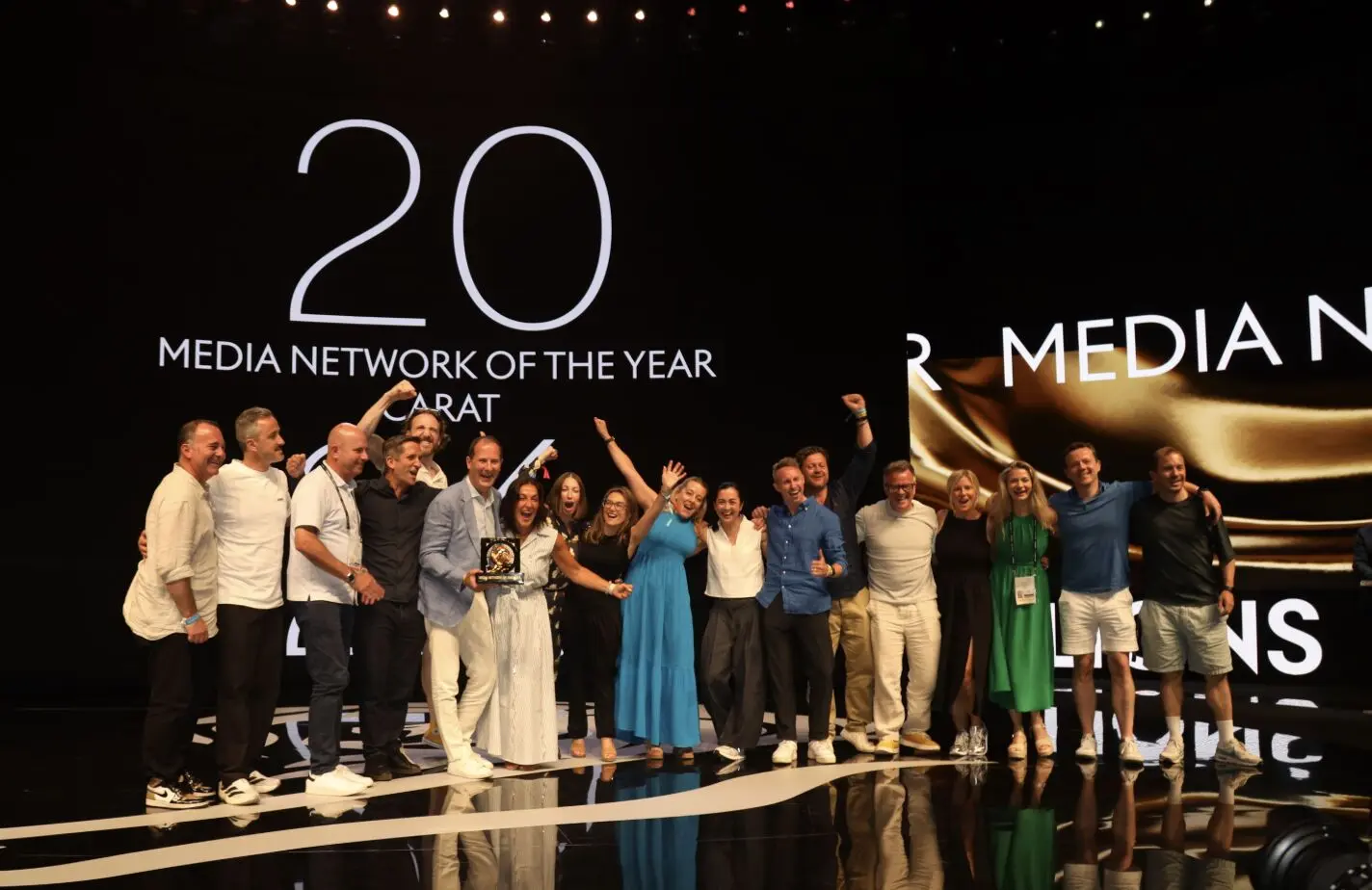
Last night (24 June) saw Carat, a premier media agency network under the Dentsu umbrella, crowned Media Network of the Year at Cannes Lions.
Sylvain Valeix, the global client president at Dentsu, sat down with MediaCat to talk about how Carat sets itself apart from other holding companies by finding the perfect partner, the perfect software and the perfect education on how to use them.
He argues that when everyone has access to the same data, the same AI ecosystems, the same platforms, a modern strategist has to be able to not just look at the current trends, but track down blind spots and hidden variances to produce real, actionable insight.
How does Carat sell and position itself as a media network?
I think as an agency, we truly believe in the power of the craft of media. Nowadays there is a bit of a tendency [to believe] that AI will solve everything. And for us, the tension between AI and PI (physical intelligence) is what makes the difference.
So, technology is everywhere. It’s very pervasive. But ultimately, how does it route back to very human insights? How does it help create love for the brands that people are consuming?
And that balance is really what’s striking and what gets rewarded ultimately at Cannes. If you take Plenitude [the Dark Mode Ads campaign] it’s very much about helping sustainability, helping humans, but using technology to be able to scale that ultimately and create that. Heineken [the Could Have Been A Heineken campaign] is the same thing. It’s a technology statement. Ultimately, you are considering more time spent on voice notes, and you are flipping that to human insights and engaging with audiences, playing on that deep tension that exists in today’s ecosystem.
Ultimately, it’s about building brands that humans love but also that algorithms reward.
You talked about the craft of media. Do you think it’s changing? And if so, what are the craft skills that are important for a media planner or a strategist in the future?
I think it’s a great question and one that we have not sussed out yet, fully. But ultimately, the algorithm averages and optimises. And for us, the craft is about finding that delta to the marketplace, that hidden value that you’re able to find through those deeper insights.
So, if you rely only on the ecosystem to guide your marketing, you will be optimising the same as any other brands. Therefore, brands’ differentiation has to come through the blind spots, through rich insights that you’re able to factor in to be able to create that delta in value. So that requires very strong strategic craft, but also very specialist craft as well.
We see a lot more discussion on how you glean an insight. Our LLM teams, search teams, signals teams, are far more integrated nowadays with our strategic units to be able to find those hidden spot of value in the marketplace.
The old analogy is that a good media planner or a good media buyer is like a stock picker. Do you think that’s still true?
I think this is very true. If you look at the way the financial market is working through algorithms, this is where we’re going. Ultimately, we live in an algorithmic world, everything is being transacted now on bidding auctions, or will be in the very near future.
But you still need that interpretation, that analysis of the market and the consumer to be able to bet on what is the good price for an impression, and layering all the attention intelligence that at Carat, we’ve invested significantly behind, to find that hidden value.
What sort of training and skill sets are you prioritising for your younger, or even your senior staff at Carat?
They need to be fully literate in the ecosystem in which they operate. So, them being accredited with the largest platforms is a must.
We have dedicated craft skills education programs, which has now an AI component to it. But again, that is craft skills training powered by AI, not the other way around. And I think this is really where we see a differentiation. We do not believe in creating a walled garden ourselves.
Those craft skills permeate through the whole solution of Dentsu. And more and more, we are breaking down all the silos and creating solutions that are horizontal across our business service lines — creative, CX and media — to add the value that our clients seek. Media is a fantastic canvas; it’s like the connective tissue. But to execute upon it, you need to bring that integration between disciplines as a single point of contact to be able to kind of harness those fast currents in the marketplace.
What else is on the curriculum at Carat?
We have total social — social-first communications. We have media and production. Ultimately, we think that the delivery engine will become far more integrated and the content analytics need to not only be bespoke to media, but also include which asset performs best in a far more dynamic manner. We have modern CRM.
The list goes on. I mean, we have commerce as well, which is obviously one of the big areas of interest of our clients. But what we’re trying to do is get people to be versatile enough to be able to understand all those solutions, which are all solutions that we worked on with our clients to prioritise.
I think it’s an important point. When we talk about client centricity, I think Takeshi [Sano, president and global CEO of Dentsu] has gone on record talking about us as tigers versus elephant. We want people to be nimble enough and understand the solutions to be able to bring and assemble the right skill set and talent to be able to answer what is rooted deep down in the needs of our client.
One of the great things with our whole company is we are Japanese; we take the long-term view. We’ve developed thought leadership such as consumer vision, which enables us to anchor into the future the solution that we want to build. Those solutions then get prioritised based on the needs of the clients, and then get formed as part of the training so that all our workforce is fully equipped to be able to deliver on those.
You mentioned using media to build brands. Do you think that’s becoming harder as more platforms seem geared toward routing messages to existing demand rather than creating new demand?
Well, I think this is exactly why you need a scaled agent like Carat. This is about defining those white spaces. If you go into the ecosystem, you get optimised to oblivion.
We talk a lot with our clients about through-the-line planning, because for our clients, those ecosystems are only part of the equation. For Heineken, a beer mat is as important as a barman’s recommendation, as an ad on social media. How do you navigate that?
We’ve developed bespoke tools for through-the-line planning that enables us to have a unified view across touch points and be able to plan and optimise across all of those touch points, whether they be paid, owned or earned. And that is truly resonating with our clients because ultimately, that’s the challenge that they face every day.
How do I allocate my marketing mix? It seems a very simple question, but when the complexity of the media environment is multiplied, it’s a very hard one to answer. So, we provide part of that answer and, more importantly, a great platform for discussion for their internal teams to rally around what is the right way to orchestrate their resources behind those goals.
You mentioned the complexity of the media ecosystem. While that’s obviously true, do you feel like things have gotten easier in the past year or 18 months, in the respect that a lot of the new platforms are starting to adopt behaviours that look more like traditional media? A lot of the streamers have brought in advertising, a lot of social is now more focused on creators broadcasting, and organic doesn’t play as big a role. I’m wondering, has this been a rare fair wind for the media industry?
I’ve been on six, seven panels about creators in my time at Cannes. I think everybody’s wrestling with that.
Within our client base, there is a realisation that, yes, organic and, yes, playing in culture is a very important part of how you deploy your communication but that paid is that fuel — it’s that catalyst. Earned on its own doesn’t have the reach, especially in those ecosystems.
Yes, you might have the odd exceptions, but ultimately, it’s about how do you create that system for growth that leverages all those assets, paid being one of them, to really supercharge their approach to market.
I think you mentioned the complexity of the marketplace. This is really where we see AI really helping us. As I said, we believe in the human craft to find those gaps and those sources for growth. But AI helps us with those trillions of signals.
So, we believe in a truly open and interoperable world, and our consumer intelligence and LLM intelligence treats trillions of signals. But now we’re able to do it at scale through agentic workflow, so that you’re able to distill trillions of data points into rich insights that you can glean and prioritise to be able to reach your communication.
I think this is another important point. Those platforms provide those insights. We’ve partnered extensively with hyper-scalers so that our tooling connects directly to them, not recreating our own thing. There is definitely an acknowledgment from those hyper-scalers that we are better together. And that yes, the discipline of media is increasingly required in today’s environment.
That’s why I say we distinguish ourselves from the other holdcos because we feel that we were the first agent, and we remain the true scaled agent in today’s environment. These are very much required to give independent advice based on all the richness of the ecosystem, and our ability to plug them in and bring them back into a manageable format for our clients, so that they’re able to make the right decisions.
When you call yourself the true agent, do you mean you don’t do principal-based buying?
It’s more we are not intending to build an ecosystem that links up data and washes money through the whole ecosystem.
We do proprietary-based buying, and our clients are engaged in those conversations. But for us, it’s not the idea of literally connecting end-to-end with very little visibility on that connection. It’s either you sign into it or not.
We believe in working with the hyper-scalers for that data to be transparently played back into our clients’ ecosystem through our platform Dentsu Connect. And proprietary is part of the answers because they want to have a financial advantage with that. That’s fine. But really, it’s not about tying somebody to a solution. It’s about working out what is the right solution and for the client to make a choice. And this is the original role of an agent. An advisory role that is as neutral as can be and not guided towards technology margins, or data margins or media margins.
What do you think are the most important things that a media network can do to organise itself, to be fit for the future?
Your access to the right technology, to the right data, to be able to inform the right decision is absolutely vital.
How do you put that software layer on that data that truly equips the client to make the right decisions, knowing that they have to bring short-term and long-term back together? Ultimately, you need to have a multi-speed system in which you operate. Part of the research that we’re going to be talking about today is all about that. How do you do modern video, in dynamic, long-and-short-form in the future is absolutely vital.
And then it’s about the infrastructure that you build, so those solutions that equip and that power the whole network and that can be flexed ultimately to the client needs is the three core components that I see as a successful layers for the operations.
WPP seems to have a very clear philosophy about probabilistic targeting, and they’re very data privacy-focused. Publicis is betting that the future is deterministic, being able to identify consumers. Does sit in one of those camps, or is that again somewhere where you take flexibility?
I think it’s exactly the point of flexibility. Deterministic data happens in certain geography, not in others. If you put all your bets into this, you’re missing part of the equation. The probabilistic work is absolutely vital to us.
For us, it’s how you combine those two in the most effective way and are able to flex based on the geography and the regulation that is taking place in the regions that should shape those arguments. Regulation evolves. New systems are being brought into the market and we need to be able to, in real time, flex to that.