








Media Futures Market is an unusual agency. It used to be an online marketplace for media, but it’s now a floating media department, which creative agencies can hire when they want to extend the services they offer a client.
To find out more, we had a chat with Dan Gee, the agency’s chief strategy officer. He spoke to MediaCat UK about the evolution of Media Futures Market, its focus on the ‘messy rest’ of media, and his bull and bear predictions for the future of media.
Media Futures Market used to be a kind of DSP, but now it’s something else. What is it?
Actually, it was a marketplace, but it wasn’t ever a programmatic marketplace. It wasn’t so much a DSP as being a way in which buyers and sellers of media could connect, but it was always via direct relationships.
And it operated largely across what we’ve come to call the ‘messy rest’. So it included digital but also press, radio, out-of-home and retail media, amongst all other channels. But it evolved from that, and the managed service overlay on top of [the marketplace] became the dominant model and we evolved to become a media agency.
One of the groups of companies that were most interested in our platform was creative agencies, so specifically, we have evolved to become a media agency that specialises in embedding with creative agencies to become their media department.
So, you’re essentially a media agency that creative agencies can plug in when they want to do media for a client?
Exactly that.
You’ve recently become the chief strategy officer of Media Futures Market. What does that mean?
It’s a very good question. We are still a relatively small business, with 12 people across the UK and the Netherlands. But we want to make sure that we stay true to our belief in strategy-led media rather than channel-led media. A lot of independents will operate as channel specialists, whether it’s digital specialists or out-of-home specialists. We are resolutely omni-channel and resolutely focused on making sure that we’re making recommendations and building plans to activate media that unleashes the full effect of great ideas. And you can only do that if you’re completely channel agnostic. Part of my role as CSO is now to make sure that we don’t, as we scale up, dilute that commitment to strategy-led media planning.
What keeps you interested in media and marketing?
I’m just fascinated that it works. Human beings generally underestimate the degree to which we can be influenced, and I think it’s fascinating to see the role that media and marketing can play in affecting how people think, feel and act.
And I don’t think that’s ever going to be boring because the cultural foundations and technological foundations are always changing.
I also think the industry has defaulted to giving an awful lot of the control to one or two companies that are very large and have vested interests. And I think there are massive opportunities for agencies like us, but more so for the brands and businesses that we’re working with, to get a competitive advantage by approaching behavioral science, media selection, creative work, copy, all of that stuff, from a different perspective and deliberately looking at ways to be distinctive.
You’ve previously said in interviews that you believe the returns of algorithmic media buying are diminishing. Why do you think that is?
It’s not always, but I think generally what we’ve seen from clients is that their acquisition costs are going up within paid social channels. Search is evolving all the time and it’s harder to get organic audiences than it ever has been. I think there’s just such dominance, there’s less of a need for those tech platforms to do anything other than extract value from those client relationships.
Also, the same principles that underpin those algorithms are going to apply to anybody who’s using them. Yes, they’ll adapt to the category, the audience, the creative copy, and there’s going to be some really smart optimisation that takes place, but ultimately everybody’s going to be buying the same stuff. When you’re doing that, it’s much much harder to show up in a way that sticks with audiences. We’ve got to a stage where thumb stopping is an arbiter of good. And I think, actually, brands have every right to be a bit more ambitious. Stopping a thumb is a low bar.
Where do you think the media opportunities are?
I think people undervalue or have tended to undervalue public media consumption — the type of media that reaches more than one person at the same time, and the person experiencing that media knows that other people are also seeing and experiencing it. Like when you’re watching a show on your TV, you know that other people are watching that show on your TV. So when you see an ad within that space, you know other people have seen that same ad or are likely to have seen that same ad. And that tells you it’s a brand that is big enough to be seen by lots of people, a brand that is confident enough to put itself out there, and that builds alongside the familiarity and the specific messages of the ad.
It’s the same within more ambient media. Out-of-home, which perhaps has a lower dwell time, but is incredibly public. I think that’s why out-of-home often manifests as a first foray into above-the-line media for brands that have historically been in DTC — it’s poking their head above the parapet in a relatively cost-effective way.
How do you convince marketers and brands to invest in longer-term plans when they’re being pressured to deliver the maximum uplift in the short-term?
I think it’s about being really confident about the impact that you can have. We’ve also done a good job of just shifting the time frame. So, we are absolutely building a plan that’s going to drive whatever the metrics are that the business uses, but we’re shifting the measurement window from one to six weeks, from six to 20 weeks. We’ve had a couple of activations where we’ve taken that approach. We’ve proved it out through relatively simple geographic hold-out studies, and in one case, working with a retailer, we reinserted quite traditional media into their overall mix. We ran local radio, local press, and localised out of home, alongside a retail media and performance plan. And those areas that were exposed to the traditional media alongside the more digital, performance-led media saw an 8X ROI. By layering in something in the region of £300,000 within these more traditional channels, it delivered almost £2.4m in additional revenue.
Now, that requires a level of trust from your partner. You need to get eyes on weekly sales data, weekly footfall data. But we’ve found that by asking for that kind of data, it does signal that you’re serious about what you’re doing.
Is your style of media planning at Media Futures Market more resistant to automation?
There are still massive efficiency gains to be had, and we’re working hard on that. In our back end we’re building some AI-based tooling that will plug in data points from vendors.
You can do it within a ‘messy rest’ if you know what your trading rates are for press and you know what your audiences are going to be. If you know what your trading rates are for poster sites and you know what your audience is going to be, you can plug that in and you can get to some quite sophisticated V1 media plans very quickly.
You can also plug in your various audience data sets to make sure that you’re efficiently reaching the audiences that you need to. One of the misconceptions about traditional media is there’s a lot of waste. But if you get your audience overlays right, you can do it very efficiently.
Where do you think the media industry is headed? Will it inevitably come together with the creative side?
I don’t think there’s anything that is inevitable within the industry. I try to have an optimist’s take and a pessimist’s take, in order to be realistic about what’s actually going to happen.
The optimist in me says everyone is having an awakening about algorithmic media because it’s claiming credit for work that’s happening elsewhere, it’s societally harmful and the platforms are not held accountable in the same way that publishers and broadcasters are, and therefore it can basically run at much higher margins and make it much harder for those publishers and broadcasters to exist. And it says we’re seeing greater recognition that the multiplier effect of bringing great media together with great ideas will be the fastest route to competitive advantage for brands.
Then there’s the pessimist in me that looks at the Cory Doctorow enshittification model, which says things are inevitably going to get worse, and the incumbents in our industry can keep [getting worse] for a very long time because they’re so dominant.
I think the balanced view is that the enshittification model is probably real but we can take hope that advertisers will recognise that, by following everyone on that same journey, they won’t be as successful as they could be — and that will give rise to new opportunities for brands, and new models of operation like ours.
Do you think this is Media Futures Market’s final form as a company, or are you building up to be something like an integrated agency?
Is it our final form? No. We want to be much bigger. But the modus in which we’re operating, where we bring creative and media together so that the multiplier effect is much more powerful, I don’t think that’s going to change. I can see that we would in future perhaps have more relationships where we’re working directly with advertisers, and we help them find creative agencies that are right for their needs, but I don’t think that’s going to be the dominant mode for us.
Can you think of any brands (that aren’t clients) that understand the modern media environment well and are using it to their advantage?
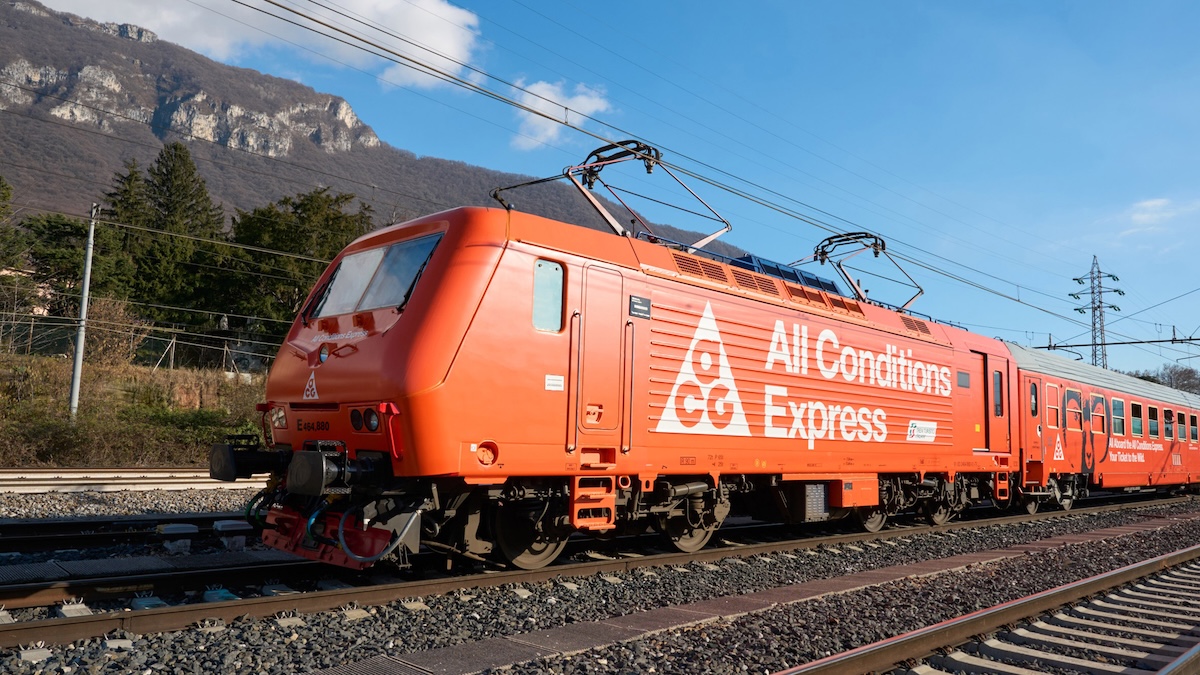
There’s one launch recently that struck me as being incredibly smart because it runs right through the line — Nike’s All Conditions Gear re-launch. They basically branded a train and took a boatload of influencers [through the Alps].
I thought it was such a brilliantly bold manifestation of what they were trying to achieve, but then they just went really hard on it. I’m sure there was a big spend in paid social, but I think they’re relying on their reach from their athlete and creator relationships to drive that amplification in a way that looks really smart. And then I was walking past the Nike store and all of the colouring and the shop design was also reflective of the media campaign. And that struck me as being a bit of a pivot from what we’ve expected of Nike over the past few years, where there has been a lot more of a focus on performance media aimed at 14-to 20-year-olds. Obviously N=1 is a very dangerous place, but my perception of it was that it was a bold and well executed combination of media and idea.