



Less than two years after the Lumière brothers hosted the first commercial movie screening at Paris’ Grand Café in 1895, Thomas Edison’s production company screened what is thought to be the first advert — for Admiral Cigarettes — beginning a relationship that would go on to define much of 20th-century media.
A quarter of the way into the 21st century, that relationship, between film and advertising, is under strain. Legacy media — from newspapers to television and radio — has struggled to compete with the scale, flexibility and data-driven appeal of digital platforms. Cinema has not been immune to those pressures, and in recent years has often been lumped into the same category: culturally important but commercially vulnerable.
In the UK, the responsibility for managing — and defending — cinema advertising largely sits with Digital Cinema Media (DCM). The sales house represents around 85% of all cinema advertising inventory, covering more than 3,500 screens nationwide. Owned by Cineworld and Odeon, it also sells inventory across chains including Vue and others.
To understand how cinema advertising is actually faring in 2025, I sat down with DCM chief executive Karen Stacey, who has led the business for more than a decade.
‘Our world is a bit pre- and post-Covid,’ she says, ‘we were hit quite hard there. But I think the basics are coming out, and in the last two to three years we’ve got a really stable audience again.’
The box office figures support that claim. UK cinema revenues collapsed during the pandemic, falling from £1.25bn in 2019 to just £296m in 2020, before recovering to £556m in 2021. Since then, the trend has been upward: £902m in 2022, followed by incremental gains.
With two weeks of the year left, 2025 is projected to break the £1bn mark. That’s still shy of cinema’s pre-pandemic peak — £1.27bn in 2018 — but Stacey says that the shortfall is the result of a structural shift in film supply rather than consumer demand.
‘We have slightly less content as a totality,’ she says. ‘Believe it or not, in 2019 about 700 films launched. Now we’re probably closer to 500. But if you compare the big-ticket films — the top 10 — they’re about the same.’
Whatever the cause, UK cinema visits are forecast to hit 132.8m this year, the highest since the pandemic but still well below the 176m recorded in 2019. You would need to go back to 1996 to find a pre-pandemic year with fewer admissions than 2025.
For many advertisers, that gap fuels a lingering fear that lockdowns did not just pause the habit of cinema-going; they broke it for good.
But Stacey believes audiences still value the cinema experience, and that streaming platforms themselves have begun to recognise the importance of a theatrical release.
‘If you look at Netflix, for example, they went big on film early on,’ she says. ‘Then probably about three years ago they moved away from it. They realised people don’t stay subscribed to Netflix because of one-off movies. That’s why they’ve gone into sport and box-set content. That’s what gets people hooked.’
Netflix confirmed last year that it would scale back its film slate, producing around 25 to 30 US features annually rather than the 100-plus it was making five years ago. At the same time, it has shown a greater willingness to give select films longer theatrical runs. This year, seven Netflix titles played in cinemas, including Frankenstein, which spent three weeks on the big screen before being made available to the platform.
Stacey sees that as evidence of a recalibration: ‘There was an underestimation of the halo effect that a theatrical release gives a film. I think there’s a much better understanding of that now.’
Netflix, however, publicly rejects that framing. On its most recent earnings call, CEO Ted Sarandos insisted there had been ‘no change in strategy’, telling investors: ‘Our strategy is to give our members exclusive first-run movies on Netflix.’
The picture is further complicated by Netflix’s proposed acquisition of Warner Bros Discovery for $82.7 billion. Warner Bros is responsible for franchises including DC Comics, Harry Potter and Lord of the Rings. Some in the industry fear such a deal could accelerate the shift away from theatrical releases.
But the DCM CEO doesn’t think there’s a need to panic. ‘My personal view would be that they’re buying Warner Bros for the back catalogue,’ she says. ‘Netflix understands better than ever the value of theatrical release and the value that it has over the lifetime of a film. Instead it just feels like a bit of a land grab.’
The takeover will loom over the industry in 2026, but for now cinema advertising in the UK appears to be on firmer ground than it was two or three years ago. And Stacey needs no invitation to stress the medium’s enduring strengths.
‘We’ve got a really strong audience, and importantly it’s still a really young audience,’ she says. ‘Nearly half are under 35. There’s also an acceptance of ads. Most people go five or six times a year and see the adverts as part of the experience.
‘Around 78% of people say they enjoy the ads. And interestingly, 95% of our ads are exactly the same as TV ads — but 85% of people think they’re different.’
The problem, Stacey argues, is therefore not performance but perception. ‘A lot of advertisers used to think of us as out of home,’ she said. ‘But we think of cinema as part of audio-visual. We’ve worked hard to make sure the language we speak complements other AV media. Advertisers should think of us as part of the TV schedule.’
To make that easier, DCM has worked with PwC to convert cinema audiences into TV-style ratings. ‘Over a weekend, we can say a certain film delivered 11 16–34 ratings, or eight 16–35 ratings,’ Stacey says. ‘When buyers are building their TV schedules, we’re saying: add us in exactly the same way.’
DCM is also leaning into the granularity of its data. ‘I can tell you, at quarter to nine the following morning, for every cinema and every showing, exactly how many people attended,’ she said. ‘I could tell you Tottenham Court Road Odeon yesterday played Wicked at 3.50pm and how many people were in the room. That’s something we don’t shout about enough.’
The ambition is clear. ‘We want to prove cinema is the most powerful AV medium,’ Stacey said. ‘Our North Star is 5% of AV spend. Right now, we’re around two [percent]. All our research shows that around 5% is where you get the best return on investment.’
DCM studies back up cinema’s effectiveness. First, research conducted with Lumen in 2022 found that viewers watch an average of 24 seconds of a 30-second cinema ad. By comparison, attention drops to 14 seconds for TV ads, four seconds for non-skippable YouTube ads, and just two seconds for in-feed Facebook ads.
Second, a piece of DCM research released this year, Maximising price: The role of media, found that a brand’s media channel choice can significantly improve the ‘optimal price’ consumers are willing to pay for the product. Cinema came out on top, delivering an uplift in optimal price of 12% compared to the all-channel average.
Cinema’s biggest strength — that the experience has barely changed — is also a source of scepticism. Compared with other media, it can appear short on innovation.
Stacey thinks the reality is more nuanced, pointing to a number of recent campaigns. 4DX, which introduces physical effects into screenings, has been the ‘big innovation’ in recent years. Currently 34 Cineworlds across the UK are 4DX but there’s plans for expansion in the future.
Sky Glass was one notable brand that got involved in 4DX this year. A jungle-themed ad featuring Andrew Garfield used wind, rain and physical seat motion to capture audience attention.
‘We’ve also done our first “smelly vision” campaign with Lynx for their new cherry spray’, Stacey said. ‘We’ve used water before in 4DX, especially for car ads, but we’d never used scent. That was a first.’
This year, DCM also worked with 3Rock Global on a 3D Anamorphic ident in Cineworld theatres for the RAF that saw a fighter jet come out of the screen — all without the need for glasses. Other innovations are subtler. ‘We’ve played with screen time in different ways,’ she added. ‘We’ve turned trailers into a programme, with bumpers at either end, so it looks like sponsored content.’
One of the main challenges, she admits, is predicting breakout hits. Few expected The Minecraft Movie to be the juggernaut it was, for example, and by the time it’s proved popular it can be too late for advertisers to get involved.
To address that, DCM is exploring more flexible trading models, inspired by products like The Trade Desk’s Sports Surge. ‘If a football match goes into extra time, inventory can be pushed in real time,’ Stacey said. ‘We’re thinking about how cinema could operate in that world. If something breaks out — a Minecraft-type moment — how do we release inventory late and make it accessible? We’re calling it something like “Box-Office Surge”.’
Despite those changes, one thing about the industry will not shift and that’s the limits on the amount of advertising. ‘We only have 12 minutes of advertising before the film,’ Stacey said. ‘Ten minutes, then the silver spot before the trailers and the gold spot before the movie. That’s contracted. We can do less, but we can’t do more.
‘That’s ultimately a good thing. I worry about media owners who seem to have no self-regulation. We really care about what the ads look like. We watch every single one before it goes on screen to make sure it meets a certain standard.
‘What we offer on screen is our gold dust, understanding the value that it brings and I think the strongest strategies are always about what you don’t do, rather than what you do.’
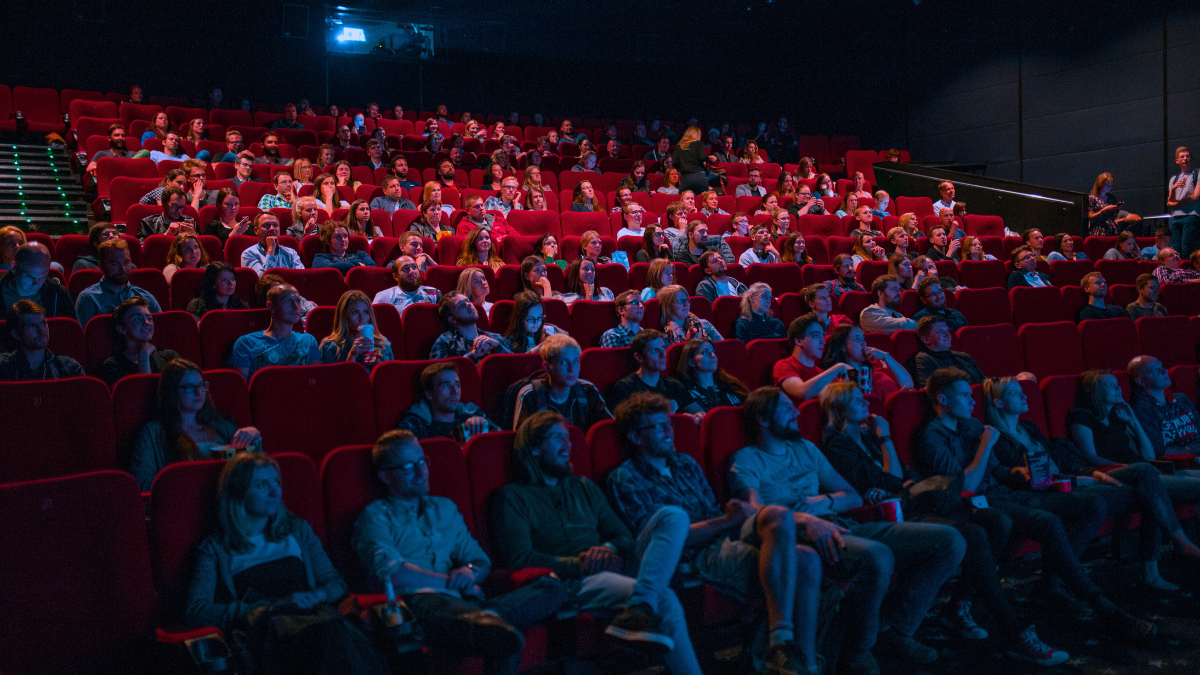
Main image by Krists Luhaers on Unsplash.
For more analyses of how different media channels performed in 2025, download the MediaCat Annual here.