


Ben Woods is a former national newspaper journalist who now covers the creator economy as an analyst at MIDiA. He speaks to MediaCat about his firm’s new research into the different types of attention that define online media, what successful creators have in common, and how brands can leverage their content to build fandoms.
What does the creator economy comprise today, exactly?
The creator economy emerged around this democratisation of not just creation but also distribution. We’re talking about smartphones, affordable editing software, and then the social platforms themselves, which enabled creators to find audiences and distribute video content or music content without needing those traditional media gatekeepers. Today the creator economy is so much broader than that. It’s not just individual influencers and YouTubers. It’s the platforms, the technology companies that support those platforms, the agencies, and the production companies that represent creators and influencers. And brands not only fuel — through their spending — the creator economy, they’re increasingly becoming creators themselves.
What defines the creator economy is not really who is creating the content but this audience-centric playbook that sits underneath it all. It’s building a direct relationship with your audience, growing a community and monetising attention across multiple channels. As a result, we’re seeing traditional entertainment wanting to get in on the creator economy and what it offers. We’ve got broadcasters working with creators, brands producing entertainment and obviously creators increasingly operating like media companies.
You’ve created a framework for turning audiences into fans that identifies three layers of attention. What are these layers and how do they differ from each other?
The framework came from this observation that not all attention has the same value. We talk about the attention economy all the time; why it’s really important and how it dominates decisions.
Someone who’s casually scrolling a feed is displaying a very different type of engagement to someone who’s sitting down and watching every episode of a show, or a fan who’s buying merchandise and creating content around the IPs they love.
We wanted a framework which allowed entertainment companies, and anyone working in the creator economy, to unpack attention. The three layers [are] disposable attention, habitual attention, and devotional attention.
Disposable attention is fleeting engagement, driven by the feeds and algorithms. Think about someone who’s scrolling through short videos on TikTok or Instagram. They’ve got attention, but it’s often directed towards the platform rather than the specific creative brand or piece of IP. They’re just moving from one video to the next. While these feeds provide great opportunities for discovery, they also provide the opposite. People are very quickly moving from their creators to perhaps watching a trailer to watching a piece of branded content. It’s all happening very quickly.
Then there’s habitual attention, which is repeat engagement driven by routine. Someone who might watch a creator’s livestream every week. Someone who listens to a podcast during their commute because it regularly drops at the time that they’re commuting. Someone who returns to playing the same video game each evening. The relationship is basically consistent, but it’s not necessarily something that’s emotionally driven at this stage.
Then we’ve got devotional attention, which is basically fandom — where audiences become fans. These are people who are actively seeking out content. They’re following creators across platforms because they’re such big fans of them. They’re buying the products and merchandise of their favourite anime show. They’re attending events. They’re recommending content to others and creating their own content.
For entertainment businesses, you don’t simply want to maximise attention; you want to move audiences away from disposable attention towards devotional attention because that’s where the deepest engagement, loyalty and value lies.
Do platforms and formats shape the kind of attention that content receives?
Formats do have a big part to play in all of this. Short-form video is highly effective at capturing attention quickly. Long-form video is better at sustaining attention. Interactive formats, such as gaming, are good at creating very deep engagement because audiences are active participants in what they’re doing.
But the format itself doesn’t determine the value — it influences how likely audiences are to move from casual engagement to fandom.
Lots of different behaviours take place within these formats. For example, short-form video is a place where people can often discover what they want to watch or what type of entertainment they want to consume next. It can be this real staging post towards a deeper engagement, and there are ways and techniques in which I think entertainment companies can use that discovery element of short-form video to deepen engagement. But it can also be a place where people just consume the content that they want to watch and they don’t want to go deeper.
We have some really interesting statistics, for example, around podcast consumption. When we asked consumers how they preferred to consume podcasts, 24% said watching full video podcasts. But then we also had 18% that said they wanted to watch podcast clips on short-form video platforms. So they’re not going deeper to long-form type engagement with podcasts. That can be problematic because actually we know that — whether it’s monetisation or things like ad loads — long-form is better for entertainment content providers and creators because they can make more money from it.
Why doesn’t engagement equate to commercial value?
Well, not all engagement is equally valuable. In the past we would look at social platform metrics as some of the real key indicators of attention, but that’s increasingly becoming hard. They’re not clear in translating what looks like a big audience into a strong commercial outcome. Followers are the classic example. [Following] shows interest, but it doesn’t really show commercial value and loyalty. To understand the commercial value you’ve got to look at how to measure engagement in a commercial way. It’s got to be down to things like, how often fans spend money on the entertainment that they love. We’ve got data here that shows, not surprisingly, the more time fans spend with entertainment content that they love, the more likely they are to spend money on that entertainment.
Actually, a really good indicator of how valuable a piece of IP or creator is, is how much content is being created by the audience around that creator. If you’re seeing lots of videos created, seeing lots of remixes or clips shared, that shows there is a deep level of fandom because these people are stepping beyond just consuming. They’re also creating. Every time an audience or a fan creates they’re creating even more visibility for that creator.
How much of that is dependent on the nature of the content? When I think of someone like MrBeast, for example, that’s not content that’s easily replicable.
I think when you’re looking at someone like MrBeast, what you can see is that he obviously has a huge and significant following in terms of the channel size and subscribers. He’s taken that IP and built out different commercial streams from it, whether that’s the chocolate bar stream, or collaborating with other creators to grow his outsized presence. What we see a lot from MrBeast now is collaboration with other big-name live streamers to create events, formats similar to classic TV game shows. I think, for MrBeast, it’s a case of understanding that he doesn’t necessarily represent the whole of the creator economy because he is so enormous.
The middle tier of creators are those who have managed to build a niche or audience around their content. They’re not necessarily millionaires, but they’re making a good income. They’re still valuable to brands because they have that trusted buy-in. Sometimes it’s not about the sheer scale of a creator’s following, but how committed and trusted the relationship between the audience and the creator is. That is where good commercialisation can happen. That’s why sometimes it can be deceiving to focus solely on the size of followers or subscribers.
How should brands change their approach to creator partnerships in light of this dynamic?
I’m probably not going to reinvent the wheel here, but I think building relationships with creators is key. Not just seeing them as talent or renting attention from them. Reach does matter, but the most valuable creator partnerships [are] increasingly those that tap into fandom, trust, community, rather than just the impressions that they generate. For example, you don’t want to be thinking about how many people saw this video, but more [about] how many people really cared about it and whether this creator has the ability to turn that fandom, care and trust into commercial benefit in the end. That’s quite hard to quantify, but there are some best practices for working with creators. One is: be trusting. If you decide, as a brand, that you want to work with a creator, you’ve done your homework and come to the conclusion that this is a good fit for you, then you really need to trust the creator’s creative vision and give them the freedom to support your brand in the way that they want to do it. I think the mistakes are often made where brands think, ‘OK, we can plonk this creator in the middle of a campaign and tell them what to do. Just the sight of their face on a video will be enough.’ But it often isn’t the case.
Allow that creator to work directly with the digital teams within brands because it’s not necessarily about the content itself, but also about the packaging of that content. I won’t name them, but [a brand] brought in a really high-profile creator, spent a lot of money producing a branded entertainment show, but then the packaging at the end of it has been very basic, and therefore it hasn’t really travelled on social.
Can you think of any brands that have done a good job at this?
The one I really like is the Waitrose supermarket podcast, The Dish. People use that example a fair bit, but rightly so. They have embraced that creator mindset. They moved past this idea that the only way brands can engage with audiences is to interrupt attention. They decided that they want to become creators and entertainment companies in their own right, but what they’ve chosen to do is not to slap branding on everything or to force commercial messaging. They’ve realised that the best way to build that relationship is to actually entertain people and give them valuable content. I think those brands who want to embrace the creator economy will do a much better job if they try to engage by building deeper and more durable relationships rather than just focusing on how they can promote themselves. The Dish is a great example because audiences are spending significant amounts of time with it. It’s branded but in a subtle way. And the guests that they have now compete with the prime-time TV chat shows, so I think it’s a formidable brand entertainment story within the creator economy.
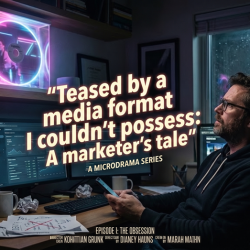
The next one to look out for is microdramas. That is happening in a big way at the moment. [We’re] seeing the likes of Maybelline moving into that sector. It’ll be interesting to see whether brands, who have done so well in podcasting, can make the leap into drama as well and build meaningful relationships. I think that presents new challenges. I’ll be curious to see how that evolves.
When you look at creators who’ve successfully built IPs or fandoms, do they have any commonalities?
I think one of the things that they share is that they have a scalable formula for their content. With Steven Bartlett, it’s thought leadership [within] very emotional interviews. It’s taking senior leaders and showing them at their most raw. That is then bottled and used to launch other podcasts within his stable. Davina McCall is launching a podcast within Steven Bartlett’s empire.
Very similarly, if you look at Goalhanger and the way they’ve built an IP franchise, it’s essentially the same format.
What these creators do really well is hone in on what it is about their content that connects with audiences. Then they take that and use that formula to scale into other different strands of their content creation.
Do you advise brands to behave like creators on social media and to cultivate fans?
I think it’s fine for brands to start to think of their audiences or customers as fans, and to offer valuable and engaging entertainment to try and build those relationships, though they need partners along the way. Of course, you can always bring creators in-house. We have this rich seam of talent that exists now within the workforce because so many people — especially younger people — are doing creation themselves. But the tendency – if brands aren’t careful – is to lean too heavily into commercialising and not into entertaining. If brands want to be successful within the creator economy and nurture a fanbase they have to keep making, entertaining, and investing in [producing entertaining content]. It’s a commitment.
What advice do you have for creators that are finding distribution difficult on platforms right now?
It’s this chicken and egg situation whereby becoming a creator has never been easier, and AI is enabling that even more because having to master tools now is no longer a barrier to entry. But the more people that are doing it, the more the platforms are becoming — I don’t know if flooded is the best word — significantly filled with more and more content.
[It’s] easy to create, harder to be seen. Creators need to think about how they can maximise what they get from each platform. Sadly, it does mean that just operating on one platform alone is probably not going to be enough. No platform guarantees distribution. Those creators that build direct relationships with audiences through emails, memberships and communities are likely to be the ones that are able to hold onto their audiences when the algorithms change.
When you have the data back from a YouTube video, you get a real sense of who’s engaging and when that engagement drops off, etc. But it doesn’t allow you to directly ask your audience. I think that’s something membership services enable, which can help you with retention and growing going forward. Ultimately the goal is not to become independent of the platforms, but probably to become less dependent on any one platform. At the end of the day, social platforms are still the real drivers of discovery of content, and it’s how can you box clever between these different platforms to ensure you engage audiences, get your content discovered, but are not disproportionately harmed when algorithms change or the platform’s priorities shift.
Update (29.06.2026): This interview was conducted while Ben Woods was at MIDiA. He has since moved to Enders Analysis.