

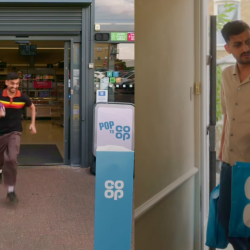


The first above-the-line ads in the multi-year, multi-million-pound campaign to encourage Brits to invest were scheduled to go live today (11 May).
The digital escalator panels will introduce people to Savvy, the red squirrel mascot that was created to take the mystery out of buying stocks, and the choice of media ties in nicely with the message about ‘taking the next step’, says Katie Scott, a client director at The7Stars, which is handling the media for the campaign.
Invest for the Future is the result of a collaboration between 20 financial services firms — including Barclays, Aviva and JP Morgan — the Investment Association, and government bodies.
Phase one of the campaign began at the end of April with branded taxis, in which people could chat about investing with financial content creators while being driven to their destination. It will also include digital audio and paid social ads that drive people to the Take The Next Step microsite. Phase two will begin in the autumn and will aim to reach a broader segment of the population, with a TV ad currently in production.
Overall, the campaign is expected to last between three and five years at a reported cost of between £7m and £10m per year.
Background
UK Chancellor Rachel Reeves announced the campaign during her Mansion House speech in July 2025, alongside other measures intended to increase financial risk taking among the population. According to a report by Aberdeen Group, only 8% of UK adults’ wealth is in equities and mutual funds, compared with 33% in the US (excluding pensions).
Originally, WPP was named as the agency attached to the campaign, but in October, The7Stars and M&C Saatchi were appointed following a pitch, along with Lansons as the PR agency.
Reporting by the Financial Times implies that cost drove the decision, citing an earlier Politico article that WPP’s plans would cost between £15 and £45m per year over three years. But Ben Edwards, a strategy director at The7Stars, says that the agency’s independence and transparency — as well as its expertise in financial services — played a big part in the win.
‘We’ve been doing a load of work in recent years trying to clean up the supply chain as much as we can, vetting all partners that we buy with, including our own programmatic desks,’ he says. ‘So, we’re confident that we’re going to show up in the right places, but also that your [advertising] pound is going as far as it should.’
The brief
The brief for Invest for the Future was for an education campaign that spoke to everyone. But the agencies began by checking whether they should do anything at all. The US attack on Iran in February was so destabilising it created concerns that encouraging people to invest their savings was a wrong move, and both Lansons and The7Stars conducted research to see if those fears were justified.
Findings from The7Stars’ quarterly tracker of public opinion showed that the fallout from the conflict in the Middle East had mostly just made people more conscious of their finances, rather than want to hoard their cash, however.
‘Our tracker showed that 26% of people said the geopolitical situation was either making them much more likely or slightly more likely to invest, and 23% of people said that it had no effect,’ says Scott.
Planning
To begin identifying the audience and channels for the campaign, The7Stars used its survey tool (Pulse) to get nationally representative responses to open-ended questions, like ‘are you investing?’ and ‘if not, why not?’, to get the lay of the land, says Edwards. The next step was combining demographic data — from Kantar etc — with the survey responses to establish what its audiences would look like and how big they were.
Scott says she ended up creating four target audiences for the campaign. At the top of the funnel were those ‘just starting out’, who save only occasionally and are far removed from the investing world, and at the bottom were the ‘already investors’, who just need to know which products and services could get them a better return.
The agency then conducted focus groups and interviews with its target audiences to get a more detailed understanding of what holds them back from investing, as well as the kinds of media they turn to for education.
‘That was really beneficial for us to understand how that would align, not just from a media perspective, but also from the comms and then the creative side of things, and making sure the messaging was aligned to the barrier that the person was facing and why they wouldn’t be considering investment,’ says Scott.
The7Stars used postcode data from a proprietary planning tool to make sure it was hitting the right audiences in the first phase of the campaign, which comprised predominantly digital media and was focused on people who were a bit further down the funnel and more receptive to the idea of investing.
Among other things, Gravity Connect (as the tool is called) pulls in O2 data that tracks people’s movement, says Scott, so the agency is able to speak to people where they work, live and spend other parts of their time. It also contains banking data from Snoop, which gives indications of people’s property values and income, as well as information about direct debits that people have set up with investment firms, which was useful for knowing who not to target with an education campaign.
Postcode data, says Edwards, was invaluable for delivering a representative campaign, and avoiding the bias towards the south-east of the country, which tends to show up in financial services campaigns.
Testing and measuring
The messages and formats used in the first phase of the campaign are being A/B tested, to ensure that the campaign is landing with each of the four audiences — ‘It’s very important that it doesn’t feel like it’s a forcing investment upon people,’ says Scott — as well as ensuring that the media is as effective as it can be.
In the short- and medium-term, the success of the campaign will be judged on sentiment, although there are some more concrete goals for later on. The statement being tracked now is whether people feel that investing is for someone like them. At the moment, just over a third of the UK feels that way.
The firms that have come together to fund the campaign understand, however, that they won’t see a return on their investment right away, says Scott, which is uncommon in her line of work. ‘Normally it’s, “We need to sell this product; how can you help?” So, it’s been really interesting to work on from that perspective.’
If fast results had been the desired outcome, might it have made sense to stress the Investment Association’s findings that £10,000 put into a cash ISA a decade ago is today worth £8,400 in real terms, whereas a global equity fund would have returned almost £20,000?
‘We definitely had that conversation,’ says Edwards. ‘But the short answer is… that’s why you do research. That’s why you do qual and speak to real people. It was wrong for a multitude of reasons, and it’s not in the spirit of what we’re doing.’