








The central question hanging over Big Tech for the past few years has been simple: when will the AI economic revolution actually arrive?
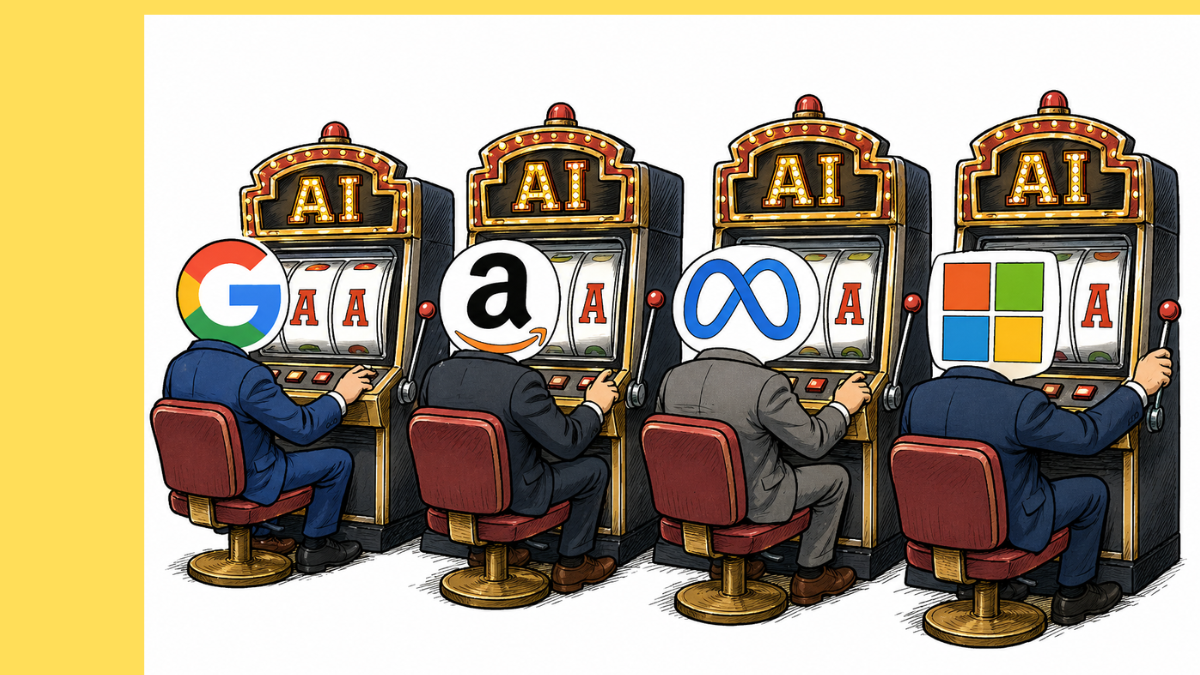
On Wednesday (29 April), four of the ‘Magnificent Seven’ companies — Alphabet, Amazon, Microsoft and Meta — had an opportunity to answer it. All posted strong earning results, with double-digit revenue growth and resilient core businesses. But we’re now far enough into the AI boom/bubble cycle that headline numbers alone are insufficient. Investors are fixating on what it all costs.
The burn is astonishing. Together, the four companies are expected to increase capital expenditure by around 77% this year, building on last year’s record $410bn. Most of that is being funnelled into AI infrastructure — data centres, chips and model training — with meaningful returns still some way off. Amazon CEO Andy Jassy said much of today’s investment ‘will be monetised in 2027–2028’, but that requires a degree of faith the market does not always demonstrate.
Patience is already wearing thin. Meta, which raised its spending forecast to as much as $145bn, saw its shares fall sharply despite strong results, while Microsoft and Amazon also received muted reactions. All three have announced significant job cuts in recent months to offset rising costs. Alphabet stood out as the exception, with shares rising 6%, helped by its strong position across several areas of AI. Even so, it, too, reported sharply higher capital expenditure and signalled further increases ahead.
For the most part then, AI is still promising jam tomorrow. But there is one area where its impact is already being made apparent — advertising.
Across all four companies, AI is improving ad performance and driving growth. Meta reported a 33% increase in ad revenue, to $55bn, supported by a 19% rise in impressions and a 12% increase in average price per ad. The company pointed to AI-driven improvements in content ranking and delivery, which have boosted engagement across Facebook and Instagram. Time spent on Reels, for example, rose 10% following AI-led changes.
Alphabet told a similar story. Advertising remains its core business, generating $77bn in the quarter, up 16% year on year — its fourth consecutive quarter of double-digit growth. Search revenue alone rose 19% to $60.4bn, suggesting Google is managing to evolve its core product without undermining it. Executives emphasised how AI is helping better interpret user intent, potentially increasing the proportion of searches that can be monetised. YouTube’s ad revenue also grew 11%.
Amazon’s advertising business continues to expand rapidly, with revenue up 24% to $17.2bn. Growth is being driven in part by AI tools that simplify campaign creation, particularly for small and medium-sized businesses. Tasks that once took weeks — such as building creative or selecting audiences — can now be done far more quickly, lowering barriers to entry and bringing new advertisers into the market.
Even Microsoft, historically less reliant on ads, highlighted a 12% growth in search and advertising, alongside the milestone of Bing surpassing one billion monthly active users.
The common thread here is that AI is making advertising both more efficient and more accessible. Better targeting and optimisation are lifting conversion rates, while automation is expanding the pool of advertisers. At the same time, it is reshaping how ads are delivered.
Search and shopping journeys are becoming less linear. Rather than a single query leading to a single result, users are increasingly engaging in multi-step, conversational interactions. Amazon calls this ‘agentic commerce’, where AI systems guide users through a sequence of questions before surfacing products — creating more opportunities for sponsored recommendations along the way.
A similar shift is underway in search. AI-generated responses are beginning to replace traditional lists of links, keeping users within platform ecosystems for longer. Alphabet’s 4% decline in network advertising revenue — ads served across third-party sites — reflects the knock-on effects, particularly for publishers.
Alongside advertising, cloud computing remains the other major beneficiary of the AI boom. Amazon Web Services, Microsoft Azure and Google Cloud all reported strong growth, driven by demand for the computing power needed to run AI systems. These companies are not just building AI — they are also profiting from others doing the same. Meta, lacking a comparable cloud business, is investing heavily to build its own infrastructure — one reason its spending has drawn closer scrutiny.
None of the companies fully answered when AI will deliver its broader economic payoff. But for now, advertising and cloud services are keeping the dream alive.