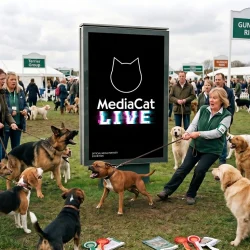





We paid Global Media to run an outdoor campaign. Six panels. One argument. The argument was that the holding company model in advertising has stopped working for clients. Global pulled the campaign before it ran its course. The reason, relayed by a company representative, was that we had referenced ‘other agencies’ and that Global ‘deals with many advertising agencies’ who are its ‘working partners’.
Read that again. A media owner cancelled a paid advertiser’s campaign to protect its revenue from the very companies that campaign was critiquing.
We are not going to pretend this does not sting. It does. But it also does something more useful than sting: in our view, it proves the argument.
The central problem we had been trying to communicate is that large concentrations of commercial interest produce arrangements where the people nominally serving your brief are, in practice, serving several other interests at the same time.
Global reaches over 51 million people every week across radio and outdoor. Its commercial model depends heavily on the budgets that flow through holding company agencies. When a small independent firm books space on that network to say the holding company model is broken, Global’s senior leadership steps in. The copy referral process, we were told, had approved the creative. It took the intervention of the senior leadership team to kill it.
This is not censorship in any dramatic or political sense. No one is being silenced by the state. What it is, more precisely in our view, is a media owner exercising editorial control over paid advertising space to protect a commercial relationship. Global’s representative was candid about it: the message was ‘too personal’ because Global does business with the agencies we named as a category.
There is a word for this in publishing. It is called editorial capture, and it has been a source of anxiety in journalism for decades. The concern has always been that ownership structures, advertiser relationships, and revenue dependencies shape what gets said. Usually the worry is about news content. Rarely does anyone notice when it migrates into the advertising inventory itself.
Agency holding companies have spent recent years expanding their influence well beyond creative services. Among client-side marketers surveyed by the Association of National Advertisers, 90 per cent cited uncertainty that principal media was in their best interest as a top concern, up from 79 per cent the year before. The relationship between media buyer and media owner has grown so entangled that a straightforward critique of that relationship apparently cannot be displayed on the network that relationship sustains.
We are a small firm. We do not pretend otherwise. The campaign we were running was direct, pointed and designed to provoke a conversation about something the industry already knows but rarely says in public.
Global’s response was to remove it, mid-flight, after the copy had already cleared their own referral process. The justification was commercial. In our view, the effect was to suppress a legitimate point of view in a public medium, on behalf of the companies that point of view was examining.
The UK outdoor advertising market is worth over two billion pounds and growing. Global is one of its dominant players. When a company that size acts to protect its client base by removing a competitor’s advertising, it raises a question that goes beyond our campaign.
If a media owner can pull paid copy because it reflects badly on its commercial relationships, what does that mean for anyone with something inconvenient to say? The answer is that you will say it somewhere else. In this case, that means writing it down and letting people read it. Global’s decision did not silence our argument, it became it.
Mike Coppen-Gardner is the Founder and Chief Executive of WeAreSPQR, a digital-first strategic communications consultancy specialising in regulated and contested sectors. Its work centres on the ‘Belief Gap’: the distance between what an organisation assumes its audiences believe and what they actually believe.